Why Training Data Matters to AI Model Performance
An AI model does not inherently understand language, images, code, speech, objects, business workflows, or expert reasoning. It learns statistical patterns and behaviors from the data and feedback used throughout development.
As AI systems have become more capable, the data challenge has changed. The question is no longer just "how much data can we collect?" Increasingly, teams must ask: Is the data correct? Does it cover difficult cases? Does it represent the task we care about? Are expert judgments reliable? Are examples sufficiently diverse? Is synthetic data verified? Are labels and rubrics consistent? Are edge cases represented?
The quality and structure of training data help determine what an AI model learns, what it fails to learn, and which mistakes it is likely to make.
AI Training Data Defined
AI training data is the collection of examples used to teach an artificial intelligence or machine learning model to recognize patterns, make predictions, generate outputs, or perform specific tasks.
Depending on the model, those examples may contain text, code, images, video, audio, structured data, sensor data, prompt-response pairs, human preferences, demonstrations, or labels and annotations. The form of the data depends on what the model needs to learn and how developers plan to teach it.
Training Data Can Teach Different Things
Datasets can teach a model knowledge and patterns (language relationships, visual features, statistical associations), tasks (classification, summarization, coding, reasoning, question answering), or desired behavior (instruction following, helpfulness, preferred response style, safety-related behavior).
The distinction matters. A dataset designed to teach factual associations is different from one designed to teach the model how to respond helpfully to a user request. Both are training data, but they serve different purposes in model development.
Training Data Changes Across the Model Lifecycle
At a high level, different types of data serve different development stages. Foundation or pretraining data establishes broad patterns and capabilities. Supervised or instruction data shapes specific task and response behavior. Preference and alignment data indicates which outputs humans prefer. Evaluation data measures whether the resulting system performs correctly.
This lifecycle view is important because training data strategy should match the model problem teams are trying to solve. Hugo's Data & AI services span multiple stages of this lifecycle, from annotation through expert-authored training examples and model evaluation.
What Types of Data Are Used to Train AI Models?
Understanding the major categories of AI training data helps clarify what teams need to produce and why quality requirements differ across data types.
Raw and Unstructured Data
Raw data includes text, documents, images, video, audio, code, and sensor streams in their original form. This data often requires cleaning, filtering, categorization, annotation, or transformation before it becomes useful for a specific supervised task.
Most raw data cannot directly teach a model a particular skill or behavior. It needs structure, context, or labels to become effective training material.
Labeled and Annotated Data
Annotation adds structured information to raw data. Examples include image classification, bounding boxes, segmentation masks, named entities, sentiment labels, transcription, speaker identification, and object tracking.
The difference between raw data and annotated data is the difference between showing a model an image and telling it what the image contains. Hugo's AI & ML Model Training capabilities include bounding boxes, semantic segmentation, landmarks, object recognition, and content categorization for traditional perception tasks.
When Humans Create the Training Example Itself
There is an important distinction between annotating existing data and creating new training examples from scratch. Human contributors may create prompts, ideal responses, reasoning problems, reference solutions, coding tasks, domain-specific scenarios, and difficult edge cases.
This kind of human-authored training data is especially important for advanced models. When a task requires reasoning, specialized knowledge, judgment, creativity, or domain context, you cannot simply label existing examples. Someone has to create examples that demonstrate the target behavior.
Why Human Authorship Matters for Advanced Models
For complex tasks, data quality increasingly depends on the capabilities of the people creating it. A mathematics task, legal workflow, software debugging problem, or scientific reasoning example may require contributors with actual domain knowledge.
This is why contributor expertise can become part of the data-quality problem itself. If you need to teach a model to solve graduate-level physics problems, you need people who can solve graduate-level physics problems to create and validate the training examples.
What Is SFT Data?
Supervised fine-tuning (SFT) data consists of examples that demonstrate how a model should respond to particular instructions, prompts, or tasks. A simplified example: Prompt → High-Quality Reference Response.
SFT datasets may include instruction-response pairs, multi-turn conversations, domain-specific tasks, code examples, expert demonstrations, and reference solutions. OpenAI's documentation notes that improvements from fine-tuning are often observed on 50 to 100 examples, with a minimum of 10 examples possible, though the optimal number varies greatly depending on use case.
What Makes SFT Data Valuable?
The value of SFT data depends on response correctness, instruction adherence, domain expertise, coverage, difficulty, and consistency. Recent research from EMNLP 2025 demonstrates that multiple intrinsic features of data quality, including instruction difficulty, response quality, and response perplexity, collectively influence model improvement. Surface-level similarity between training data and benchmarks is often less predictive than these deeper quality characteristics.
Training Models From Human Judgments
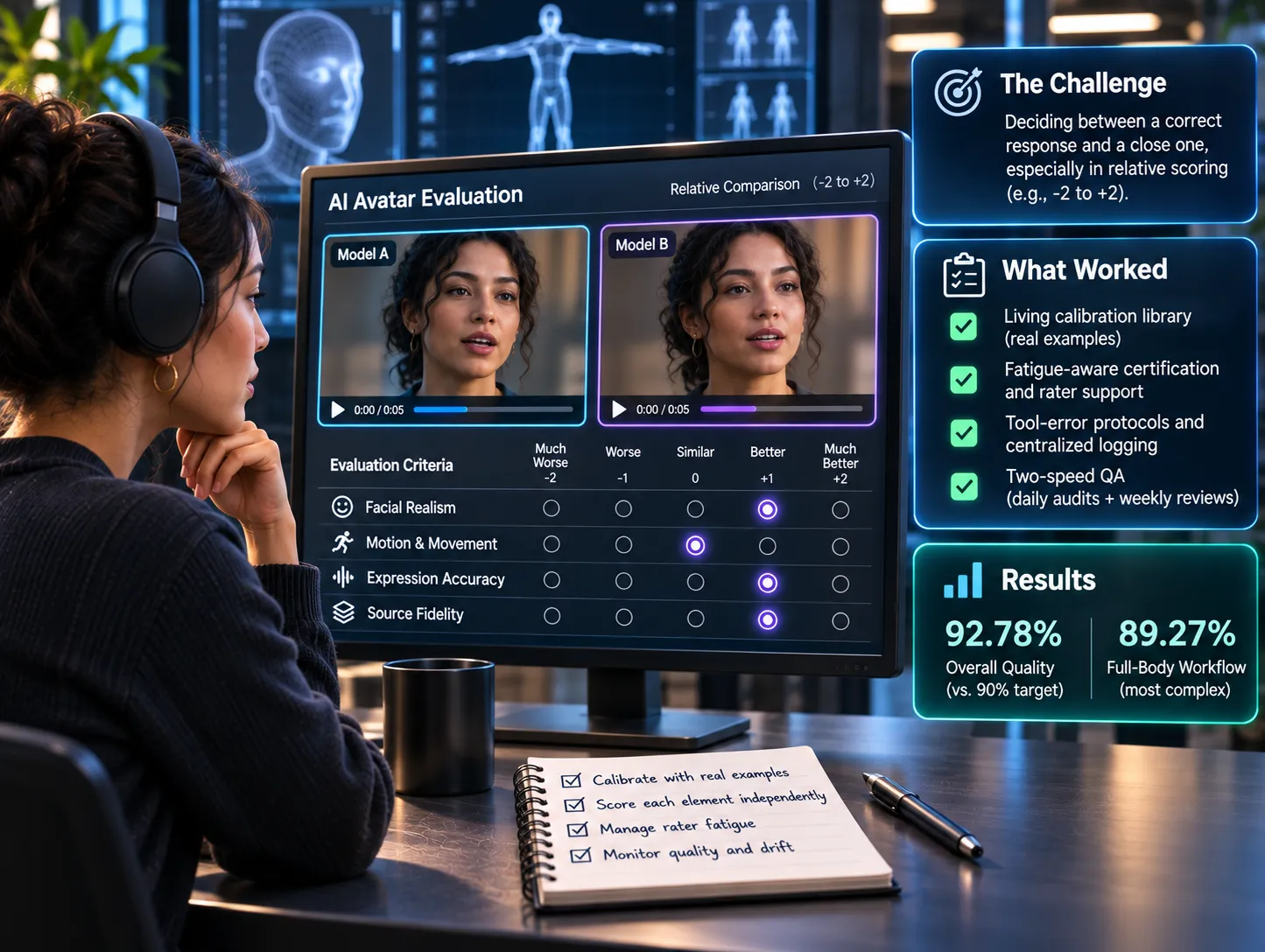
Some model-development workflows use humans to compare or evaluate possible outputs. This might involve choosing the better of two responses, ranking several outputs, grading against a rubric, identifying errors, assessing usefulness, evaluating safety, or evaluating reasoning quality.
This feedback can support alignment and post-training workflows. Hugo's Omni Evals offering includes human evaluation capabilities that span annotation, speech and audio assessment, multimodal grounding, and reasoning evaluation.
Preference Data Is Different From Reference Data
Reference data shows the model an example of a desirable output. Preference data shows which output is preferred relative to another, or how an output scores against defined criteria.
This distinction matters because preference data does not require humans to produce a perfect answer. It requires humans to judge which answer is better, or how an answer measures up to specific standards. Both forms of human feedback contribute to training, but they work differently in model development.
What Is Synthetic Data for AI Training?
Synthetic training data is artificially generated data created to supplement, expand, or target an AI model's training dataset rather than being collected directly from naturally occurring real-world examples.
Synthetic data may be generated by existing AI models, simulations, programmatic systems, humans assisted by generative systems, or combinations of these approaches.
Why AI Teams Use Synthetic Data
Potential reasons include increasing dataset size, generating difficult examples, covering rare cases, producing targeted scenarios, expanding domain coverage, and balancing datasets.
A large-scale empirical study (over 1,000 LLMs and 100,000 GPU hours) found that pre-training on a mix of approximately one-third rephrased synthetic data with two-thirds natural web texts can speed up training 5 to 10 times to reach the same validation loss at larger data budgets. The optimal synthetic data ratio converged to roughly 30% for rephrased synthetic data in this research.
Synthetic Does Not Automatically Mean High Quality
Synthetic data carries risks: factual errors, unrealistic patterns, lack of diversity, repeated model biases, duplicated examples, unverifiable reasoning, and poor difficulty calibration. Generated examples still require validation because the systems creating them can produce subtle errors that propagate through training.
Training Data Goes Beyond Text
Modern AI systems increasingly combine several modalities. Examples include text plus image, text plus video, speech plus text, image plus spatial data, video plus temporal annotations, camera plus LiDAR, and perception plus action.
Human annotation may be needed to establish relationships across modalities. This includes visual grounding, cross-modal alignment, object tracking, temporal annotation, 3D cuboids, and speech alignment. Hugo's capabilities include multimodal grounding, spatial grounding, cross-modal alignment, and LiDAR/3D annotation for these more complex data requirements.
Training Data vs. Evaluation Data
Training data teaches or modifies a model. Evaluation data measures how well the model performs after or during development. These should remain conceptually distinct.
Evaluation examples may be designed to test correctness, reasoning, instruction following, robustness, safety, tool use, multimodal understanding, or task completion. Hugo's Agentic & Coding Evals capabilities focus specifically on this evaluation side of the lifecycle.
Why Dataset Separation Matters
If evaluation examples leak into the training set, measured performance may no longer accurately represent generalization. This is why teams maintain held-out datasets, monitor for benchmark contamination, guard against data leakage, and pursue independent evaluation.
Evaluation Can Inform Future Training
A useful loop emerges: Evaluate → Identify Failure → Create Better Data → Train/Align → Re-Evaluate. Evaluation findings inform what training data to collect next. But the evaluation dataset itself should not become training data, or it loses its ability to measure genuine model capability.
High-Quality AI Training Data Has Multiple Dimensions
Quality cannot be reduced to a single metric. ISO/IEC 5259-4:2024 establishes standardized process frameworks for managing data quality in analytics and machine learning, with specific guidance on supervised learning data labeling, data preparation, data composition, and lifecycle management. These standards reflect the multidimensional nature of what makes training data useful.
Correctness
Labels, reference answers, reasoning, and judgments should be factually or functionally correct. A model trained on incorrect examples learns incorrect patterns.
Relevance
Examples should reflect the target model, task, domain, and expected user behavior. Data that is technically accurate but unrelated to the deployment context provides limited value.
Coverage
The dataset should represent meaningful variation in the problem space. That may include common cases, difficult cases, edge cases, and failure modes. Research suggests training set sizes between 3,000 and 30,000 data points depending on dataset characteristics, with 3,000 for binary classification and up to 30,000 for multi-class problems with specific feature configurations.
Diversity
Avoid excessive repetition or narrow examples that teach only one pattern. Relevant diversity can involve scenarios, linguistic forms, demographics where appropriate, difficulty, domains, environments, and interaction styles.
Consistency
Annotators or authors should interpret project guidelines in comparable ways. Inconsistent labeling introduces noise that can confuse model training.
Appropriate Difficulty
For advanced models, a dataset filled with problems the model already solves easily may produce limited value. Training examples may need to deliberately challenge reasoning, coding, domain expertise, tool use, or multimodal interpretation.
Traceability and Provenance
Teams should understand where data came from and how it was generated, labeled, transformed, and reviewed. This matters for debugging, compliance, and continuous improvement.
Independence Where Required
Training, validation, and evaluation datasets should be separated appropriately. High-quality data is fit for purpose, not merely clean or large.
Automation Can Generate Data Faster, but Humans Still Provide Judgment
Automated systems can help with pre-labeling, filtering, generation, classification, and quality signals. But humans remain especially valuable when a task requires ambiguity resolution, expert reasoning, subjective comparison, edge-case judgment, contextual interpretation, adversarial thinking, or validation of synthetic outputs.
"The hardest part of scaling AI training data isn't finding people who can follow instructions. It's finding people whose judgment you can trust on problems where there's no obvious right answer. That's where domain expertise and careful calibration become the whole ballgame."
Sean Neighbors, Strategic Account Executive
Human-in-the-Loop Does Not Mean "Any Human"
Dataset quality depends on matching reviewer capability to task complexity. Simple classification may require strong guideline adherence. Advanced mathematics may require mathematical expertise. Coding evaluation may require software engineers. Clinical or legal tasks may require specialized domain expertise.
Hugo's specialist workforce model emphasizes university-educated and domain-specialist talent for judgment-heavy AI work, reflecting this principle that contributor expertise directly affects data quality.
High-Quality Data Requires a Repeatable QA Process
Potential QA mechanisms include detailed guidelines, contributor training, qualification tests, gold-standard examples, multi-stage review, peer review, expert review, consensus, adjudication, calibration, error taxonomy, and feedback loops.
Calibration Matters
Two qualified reviewers can still interpret ambiguous guidelines differently. Calibration helps teams establish shared standards, consistent judgments, and treatment of edge cases. Without calibration, even skilled contributors can produce data that conflicts with itself.
QA Should Improve the Data Pipeline
The loop looks like: Annotate/Author → Review → Identify Error Pattern → Clarify Guidelines → Retrain/Recalibrate → Re-Review. Training-data QA should be a continuous system, not a one-time final inspection.
What Makes AI Training Data Low Quality?
Several common problems reduce the usefulness of AI training data.
Incorrect Labels or Reference Answers
The model learns from wrong examples, encoding errors into its behavior.
Ambiguous Guidelines
Different contributors produce inconsistent judgments, introducing noise.
Insufficient Domain Expertise
Contributors cannot reliably evaluate advanced tasks, leading to plausible-sounding but incorrect examples.
Dataset Imbalance
Important behaviors or scenarios may be underrepresented, causing the model to underperform on critical cases.
Too Many Easy Examples
The dataset may fail to challenge an already capable model, providing minimal training signal.
Unverified Synthetic Data
Generated examples may contain subtle errors that look correct but teach wrong patterns.
Duplicate or Highly Repetitive Data
The dataset may provide less informational diversity than its size suggests.
Evaluation Leakage
Held-out examples may contaminate training, making benchmark results unreliable indicators of real capability.
Does More AI Training Data Always Improve a Model?
No. More training data can be valuable, but additional volume does not automatically improve a model if the new examples are inaccurate, repetitive, irrelevant, poorly calibrated, or below the model's existing capability level.
The distinction is between dataset scale (how much data exists) and dataset signal (how useful those examples are for teaching the desired behavior).
High-Signal Data
Examples may be high signal when they teach something the model struggles with, correct a known failure mode, represent an important edge case, contain expert reasoning, or improve domain coverage.
For advanced AI systems, the challenge increasingly becomes creating enough high-signal data, not merely increasing raw dataset size.
Different Model Problems Require Different Types of Data
The right training-data strategy starts with the model behavior that needs to change.
If the problem is basic recognition, potential data includes labeled examples, annotation, and classification. If the problem is instruction following, potential data includes SFT, demonstrations, and reference responses. If the problem is response preference, potential data includes preference rankings and rubric-based evaluation.
If the problem is coverage, potential data includes targeted collection, human-authored examples, and synthetic examples. If the problem is domain expertise, potential data includes expert-authored tasks and specialist evaluation. If the problem is unknown failure modes, potential approaches include evaluation, red teaming, adversarial examples, and targeted follow-up datasets.
What to Look for in an AI Training Data Provider
Evaluation criteria may include workforce expertise, ability to source domain specialists, quality assurance, reviewer calibration, annotation and authoring capability, synthetic-data validation, multimodal capability, tool flexibility, data security, workforce retention, scalability, and transparency and reporting.
Match Workforce Expertise to Task Difficulty
Ask: Who is actually producing the data? What expertise do they have? How are contributors qualified? How is quality calibrated? How are disagreements resolved? How does the provider scale without resetting quality?
Evaluate the Process, Not Just the Headcount
The provider should be able to explain a coherent pipeline: Recruit/Select → Train → Calibrate → Produce → Review → Adjudicate → Measure → Improve. Hugo's glossary provides definitions for many of the terms involved in this process.
Human Data and Evaluation Across Model Development
Hugo's current AI offering spans traditional perception and annotation, model training, multimodal grounding, SFT and preference-alignment work, agentic and coding evaluation, red teaming, and broader model evaluation.
The positioning centers on managed human-in-the-loop data operations, expert data creation, annotation, domain-specialist SFT, human preference evaluation, multimodal data, quality assurance, evaluation, and scalable managed teams.
If your team is working through training data strategy for a new model capability, expanding into multimodal data, or trying to improve data quality for advanced reasoning tasks, we're happy to compare notes on what's working. For more common questions about working with Hugo, our FAQ page covers the basics.
Frequently Asked Questions
What is AI training data?
AI training data is the collection of examples used to teach an artificial intelligence or machine learning model to recognize patterns, generate outputs, make predictions, or perform specific tasks. It can include text, code, images, video, audio, labeled examples, human demonstrations, preference data, and other structured inputs.
What are the main types of AI training data?
AI training data can include raw data, labeled or annotated datasets, human-authored examples, supervised fine-tuning data, preference data, synthetic data, and multimodal data. Different forms of data are useful at different stages of model development and for different model capabilities.
What makes AI training data high quality?
High-quality AI training data is accurate, relevant to the target task, sufficiently diverse, consistently labeled or authored, representative of important scenarios, and appropriately difficult for the model being trained. Quality also depends on reliable guidelines, domain expertise, review, calibration, and protection against problems such as duplication or data leakage.
Why is human review important for AI training data?
Human review is especially important when AI training data requires judgment, domain expertise, contextual interpretation, or validation of model-generated content. Qualified reviewers can identify subtle errors, resolve ambiguous cases, evaluate reasoning, calibrate guidelines, and verify examples that automated systems may incorrectly accept.
What is synthetic AI training data?
Synthetic AI training data is artificially generated data created to supplement or target a model's training dataset rather than being collected directly from naturally occurring examples. Synthetic data can expand coverage and create difficult scenarios, but it still requires validation because generated examples can contain errors, biases, unrealistic patterns, or duplication.
Is more training data always better for AI models?
No. More training data is not automatically better if the additional examples are inaccurate, repetitive, irrelevant, poorly calibrated, or too easy for the model. The usefulness of a dataset depends on both its scale and the amount of meaningful training signal it provides for the behaviors developers want to improve.