Ask whether an animated avatar looks right, and the honest answer depends on who is looking, how tired they are, and whether the tool froze halfway through the rating. That is the practical problem at the center of human evaluation of AI avatars, and none of those three variables goes away by itself.
Automated metrics help with that question, and they scale. They also have documented blind spots. Fréchet Video Distance, a widely used measure for generated video, has been shown to weight the quality of individual frames over temporal consistency, and it can conflict with what people perceive. Its critics describe that conflict as occasional, but the pattern matters for avatars: in their tests FVD rose only slightly under large temporal corruption, so a metric like this can reward per-frame polish while missing the motion errors a viewer notices first. Avatar-specific work points the same way. A 2024 framework for rating photorealistic avatars on ten subjective dimensions found that nine of them correlate only weakly with PSNR, SSIM, LPIPS, FID and FVD, and emotion accuracy only moderately.
That is one reason human review stays in the loop, even though human evaluation of generative models has often been improvised rather than standardized. The 2019 paper that made that criticism answered it by building a benchmark designed for reliability and checking that its model rankings replicated. Reliable human judgment had to be engineered. It was not assumed.
We ran that human review for a technology company building lifelike animated avatars, including fictional characters and full-body representations. The client needed to know whether its avatars were visually realistic, emotionally accurate and faithful to their source material, and it wanted trained people making those calls alongside its automated checks.
Four workflows, one quality signal
The project ran four workflows, each with its own comparison, scale and load:
- AI Fictional Characters Absolute: raters compared a still image with the animated avatar and answered 10 questions on a 1 to 5 scale.
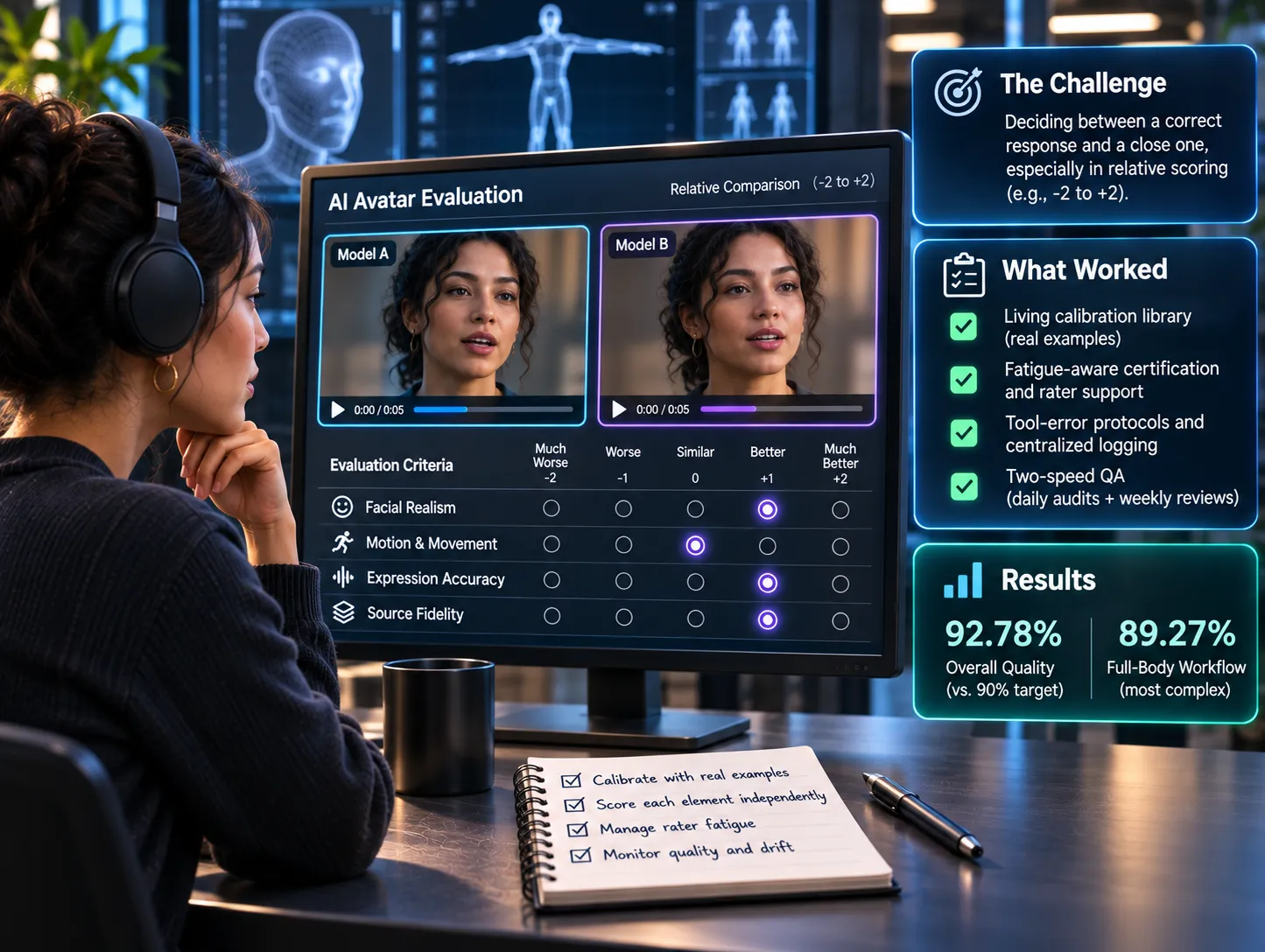
- AI Fictional Characters Relative: raters compared a reference image with two models' videos and scored 10 criteria on a -2 to +2 scale.
- CODEC Avatar QE: raters compared the original subject capture with the animated full-body avatar and answered 6 to 28 questions on a 1 to 5 scale.
- Peak Pose / Peak Facial: raters reviewed a video sequence and selected the frame number that was the best match.
Forty-seven raters completed 482,897 evaluations over seven months. They moved between formats, scales and judgment frameworks depending on assignment, which made this more than a standard annotation job. Switching from an absolute 1 to 5 score to a -2 to +2 comparison is not just a different number range. The first asks how good an output is. The second asks how much better one output is than another.
Where rater consistency breaks: the boundary between correct and close
The most persistent source of divergence was the gap between a correct response and a close one. It showed up most in relative scoring, where a rater must decide whether one model's output is meaningfully better than another's or only marginally so. People disagree on labeling judgments even when the task looks simple, and more so when it is subjective. Much of AI training still assumes a single gold answer per item. On a -2 to +2 scale, that assumption is weakest exactly where a rater has to choose between a +1 and a +2, or between a +1 and a 0.
Why written guidelines did not close the gap
Guideline text alone did not close the gap. A guideline can say "meaningfully better." Only an example from a real job shows how much better that is. What worked was calibration material built from real evaluation jobs, showing what a score at each point on the scale looks like in practice. We refreshed it whenever a new edge case turned up, so it became a living reference raters could open when a job did not fit cleanly.
Scoring a full-body avatar one element at a time
The full-body workflow needed extra attention. Raters had to assess face, arms, feet, clothing, accessories, alignment and expression in one pass, and we trained them to score each element independently, so a strong result on one did not lift or sink the others. Without that discipline, a convincing face tends to pull up the score for hands that are slightly wrong. Our takeaway on ramp-up: errors early in a project often come from cognitive load, not real disagreement, so a workflow with up to 28 criteria is better phased in than opened on day one.
Fatigue and tooling are scoring variables too
Both show up in the data as disagreement, and neither is disagreement about the avatar.
Certification covered four workflows and was demanding. A rater who fails because they are exhausted has told you nothing about whether they understand the standard. We added scheduled breaks, coaching check-ins and targeted guidance for raters whose scoring wandered mid-assessment, so a failed certification reflected a real gap and not the length of the test.
The platform mattered as well. Recurring issues such as failed job loading and validation pop-ups forced raters to decide alone whether to restart, escalate or carry on, and those individual decisions added variability. We wrote a protocol for each case, logged every incident centrally, and passed recurring platform problems to the client instead of absorbing them at the rater level.
Catching drift before it becomes a pattern
Subjective work drifts, so quality control ran at two speeds. Quality auditors reviewed completed evaluations every day for consistency across scales and criteria, and raters who fell below threshold got dimension-level feedback before returning to live queues. Weekly client QA reviews supplied an outside benchmark, and their findings fed the next day's internal calibration.
The two speeds catch different things. Daily audits catch an individual rater sliding away from the team. Weekly client review catches the whole team sliding away from what the client means by a score, which internal audits can miss because auditors and raters calibrate against the same material.
What the numbers say, and what they don't
Overall quality landed at 92.78% against a 90% target, with average handling time of 795 seconds against a target of 840. The full-body workflow closed at 89.27%, just under target. We would rather say so plainly: it was the hardest workflow on the project and took the most calibration support.
When the output is subjective, the reliability of human judgment is something you have to build, measure and keep maintaining. One of this project's hard calls is a round of The Judgment Call: see whether you would make the call our raters made.
If you're building human evaluation for AI avatars or other generated video, we're happy to compare notes.
Frequently Asked Questions
Why do AI avatars still need human evaluation if automated metrics exist?
Metrics such as Fréchet Video Distance scale well but can weight per-frame quality over temporal consistency, and a 2024 avatar study found that most subjective quality dimensions correlate only weakly with PSNR, SSIM, LPIPS, FID and FVD. Trained human reviewers judge the motion, expression and source-fidelity errors those proxies can miss.
What is the "correct vs. close" problem in avatar evaluation?
It is the gap between a response that is right and one that is nearly right, and it shows up most in relative scoring, where a rater decides whether one model's output is meaningfully or only marginally better than another's. On a seven-month avatar evaluation project, it was the most persistent source of rater divergence.
How do you calibrate raters on subjective avatar scores?
Written guidelines alone did not close the gap, but calibration material built from real evaluation jobs, showing what each point on the scale looks like in practice, did. Refreshing that material whenever a new edge case appeared turned it into a living reference raters could open when a job did not fit cleanly.
How should a full-body avatar workflow with many criteria be rolled out?
Train raters to score face, arms, feet, clothing, accessories, alignment and expression independently, so a strong result on one element does not lift or sink the others. Phase the criteria in rather than opening all 28 on day one, because early errors often come from cognitive load, not real disagreement.
How do fatigue and tooling affect human evaluation quality?
An exhausted rater can fail certification for reasons unrelated to understanding the standard, and tool errors force raters into individual restart, escalate or carry-on decisions that add variability. Scheduled breaks, coaching check-ins, a written protocol for each tool error and central incident logging keep those factors out of the scores.