Robotics Data Annotation Defined
Robotics data annotation is the process of labeling and structuring sensor, spatial, motion, interaction, and action data so robotic and embodied AI systems can learn to perceive environments, understand object relationships, track change over time, and connect observations with actions.
Unlike typical computer vision tasks, robotics annotation must support perception and action in a shared physical environment. That makes spatial and temporal relationships especially important.
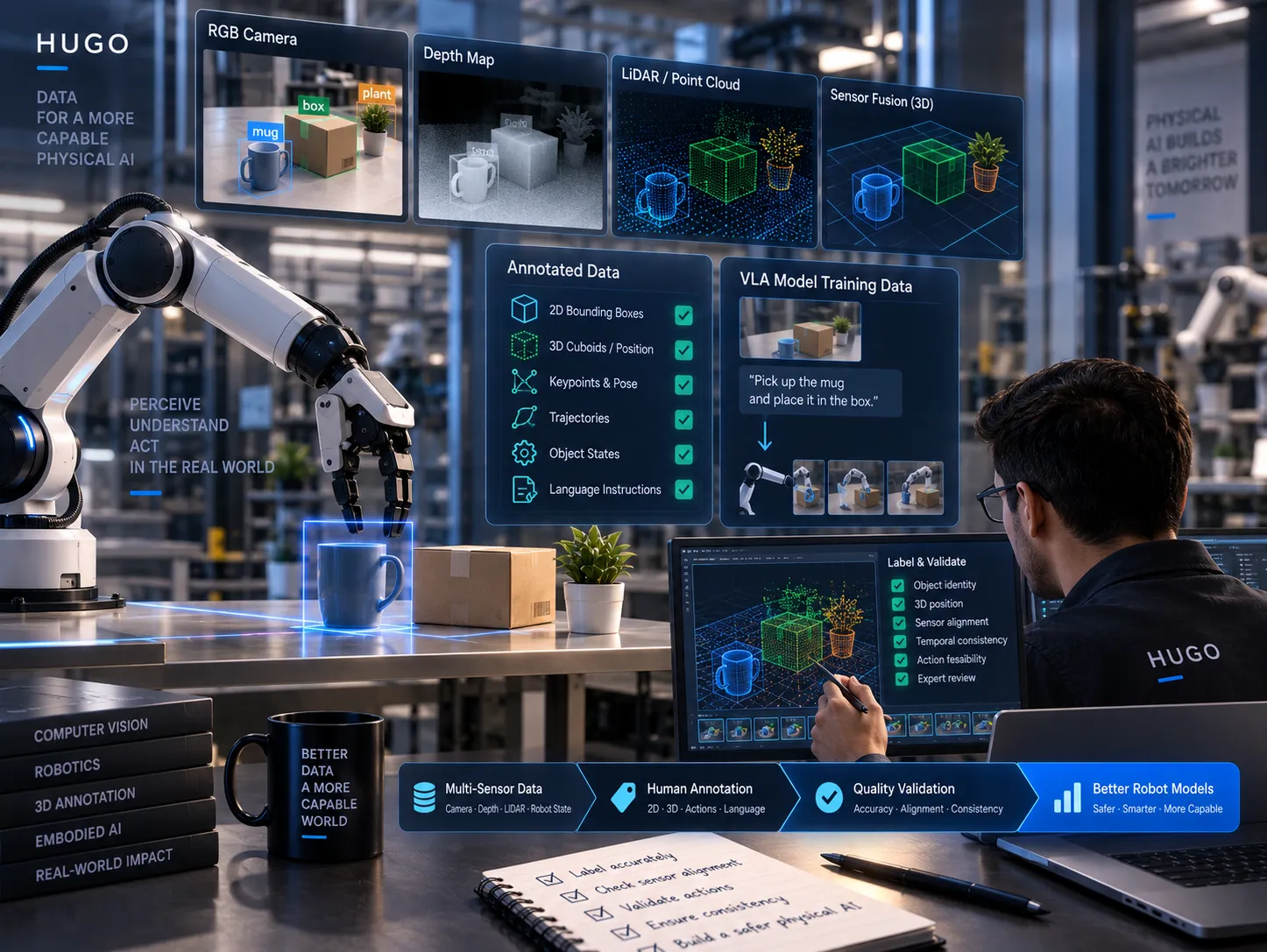
A robotics dataset might combine RGB camera images, video, depth data, LiDAR or point clouds, robot state, object state, motion trajectories, language instructions, and actions or demonstrations. The RoboSense dataset, for example, contains over 1.4 million annotated 3D bounding boxes across 133,000+ synchronized multi-sensor frames, including more than 216,000 trajectories.
A robot rarely needs to answer only "What object is this?" It may need to understand where the object is, how far away it is, whether it's moving, whether it can be grasped, how it relates to nearby objects, and what action should follow. This is why multimodal grounding matters so much for physical AI.
Physical AI Can Learn From Multiple Sensors and Data Streams
Robotic systems pull information from several sensor types. The useful training signal often emerges from relationships across these data sources rather than from any one sensor in isolation.
Camera Data: Cameras provide visual information about objects, people, surfaces, scenes, and interactions. Annotation might include bounding boxes, segmentation masks, keypoints, or object attributes.
Depth Data: Depth sensors add information about distance and scene geometry, supporting object distance estimation, spatial relationships, 3D reconstruction, and manipulation planning.
LiDAR and Point Clouds: LiDAR sensors represent the environment as 3D points. Annotation may identify objects, boundaries, 3D positions, and orientations. Point-cloud annotation becomes a critical part of the perception and annotation pipeline.
Robot and Motion Data: This includes pose, joint state, movement, velocity, end-effector position, and action sequences. It captures what the robot is doing, not just what it sees.
Interaction Data: Interaction data captures relationships like "robot grasps object," "object moves," or "item is placed into container." These are the causal connections between perception and physical consequence.
Robots Need Both Visual and Spatial Understanding
2D and 3D annotation serve different but complementary purposes. Teams working on embodied AI and robotics typically need both.
2D Annotation: Common forms include bounding boxes, polygons, segmentation masks, keypoints, landmarks, and object attributes. These help models understand what appears in the camera view and where it appears in the image frame.
3D Annotation: 3D annotation may include 3D cuboids, point-cloud segmentation, object position, orientation, depth, and spatial relationships. This adds the physical-space structure needed for embodied tasks.
A camera provides appearance. Depth or LiDAR provides geometry. A robotics system may need both. The RoboSpatial dataset demonstrates this approach, containing 1 million images, 5,000 3D scans, and 3 million annotated spatial relationships across ego-centric, object-centric, and world-centric reference frames.
Sensor Fusion Connects Multiple Views of the Same Physical Environment
Sensor fusion combines information from multiple sensors so an AI system can form a more complete representation of its environment. In training data, this requires annotations and sensor streams to remain spatially and temporally aligned.
A camera image, depth map, and LiDAR point cloud may all describe the same object. If that object is labeled "Box A" in one sensor stream, the related 3D points and depth information should refer to the same physical object.
Sensor relationships depend on coordinate systems, sensor position, orientation, and timing. Poor alignment can make individually correct annotations collectively wrong. A box that has moved 10 centimeters between camera and LiDAR capture will produce contradictory training signals if both annotations assume the same position.
High-quality sensor fusion data requires spatial and temporal consistency across modalities. This is one reason why the robotics and embodied AI space demands specialized annotation expertise.
Trajectory Annotation Adds Motion and Time
Static annotation answers: "Where is the object now?" Trajectory annotation helps answer: "Where did it move, and how did the scene change over time?"
A trajectory may describe robot movement, object movement, human movement, tool movement, or interaction sequences. This temporal structure is essential for learning how physical environments change as agents act within them.
Object Tracking: Object tracking maintains the identity of the same object across frames, viewpoints, and time. Identity switches can seriously degrade model performance.
Robot Trajectories: A robot trajectory may include sequences of states, positions, observations, and actions. These form the backbone of many imitation learning and manipulation datasets.
Temporal Events: Annotators may mark events such as approach, grasp, lift, move, and place. These action boundaries help models learn the structure of manipulation tasks.
Manipulation and Interaction Data
This is where robotics annotation moves beyond perception. A manipulation task might involve an instruction like "Put the red cup into the tray." The system must understand which object is the cup, which is the tray, their locations, how to approach the cup, whether the grasp succeeded, how the cup moved, and whether placement succeeded.
Object State Annotation: Relevant states may include open/closed, full/empty, grasped/released, upright/overturned, moving/stationary. These states change as actions are performed.
Interaction Annotation: Interaction annotation can identify contact, grasp, release, push, pull, placement, and insertion. Data may also record whether a grasp failed, an object slipped, or a task succeeded.
"The hardest part of robotics annotation isn't labeling individual frames. It's maintaining consistency across sensors, time, and the causal chain from observation to action to outcome. An annotation can be perfectly accurate in isolation and still break your training signal if it doesn't align with everything else."
Omorebokhae Sunny Ohimai, Project Manager, AI Operations
Human Demonstrations and Imitation-Learning Data
Imitation learning uses examples of behavior or demonstrations to help a system learn how to perform a task. Human demonstrations may capture observations, actions, trajectories, timing, and task outcomes.
Raw demonstrations need structure. Annotation may describe task objectives, action boundaries, object identities, state changes, and success or failure. The SPARC framework addresses this by automatically generating spatial annotations from robot demonstrations with reliability scoring, retaining 3x more samples at high-precision thresholds compared to detection-only baselines.
Vision-Language-Action Models Connect Perception, Instructions, and Actions
Vision-language-action (VLA) models connect visual observations and language instructions with actions, allowing an embodied system to interpret a scene, understand a task, and produce an action sequence.
A conceptual example: a robot sees a workspace (visual observation), receives the instruction "Move the blue block beside the green block" (language), and produces the corresponding action sequence. This extends multimodal grounding from understanding a scene to acting within it.
Training examples may connect images or video, language instructions, robot states, object states, trajectories, actions, and outcomes. The EmbodiedScan dataset illustrates this approach, providing multi-modal 3D perception annotations including 3D bounding boxes with orientation, semantic occupancy maps, and language descriptions.
Human annotators may help ensure the instruction matches the scene, referenced objects are correctly grounded, actions correspond to the task, and outcomes are labeled accurately.
Robotics Data Quality Depends on Geometry, Time, and Cross-Modal Consistency
Quality in robotics annotation has dimensions that don't exist in most labeling tasks.
Annotation Accuracy: Objects, actions, and states should be labeled correctly.
Spatial Accuracy: Positions, boundaries, depth, and orientation must reflect the physical scene.
Temporal Consistency: Tracks and actions should remain correctly aligned across time.
Cross-Sensor Alignment: Camera, depth, and LiDAR annotations should describe the same physical environment consistently.
Object Identity Consistency: The same object should retain its identity across frames, sensors, and actions.
Coverage: Datasets should include relevant environments, objects, orientations, lighting conditions, task variations, edge cases, and failure scenarios.
Human Review and QA for Physical AI Data
Complex robotics data requires QA across the entire scene and trajectory, not just individual labels. Methods include annotation guidelines, qualification tasks, calibration, automated geometry checks, cross-sensor validation, trajectory consistency checks, expert review, and adjudication.
Common Errors: Examples include incorrect 3D cuboids, LiDAR-camera mismatches, identity switches, wrong depth relationships, missed state changes, incorrect action boundaries, and instructions referring to the wrong object.
Automation can detect invalid geometry, impossible coordinates, missing fields, and timestamp problems. Human reviewers can evaluate ambiguous scenes, interaction meaning, object relationships, complex manipulation, and domain-specific correctness. Teams doing serious work in this space often need both data visualization and engineering capabilities to catch problems at scale.
Build Physical AI Data That Connects Perception to Action
If your team is building robotics training data for perception, manipulation, imitation learning, or VLA models, the quality bar is high. Sensor fusion, trajectory consistency, and cross-modal alignment require specialized workflows and reviewers who understand the domain.
Hugo supports teams working on physical AI with robotics data annotation, 3D and LiDAR labeling, sensor fusion workflows, trajectory annotation, manipulation data, and VLA data annotation. If you're wrestling with any of these challenges, we're happy to compare notes.
Robotics Data Annotation FAQs
What is robotics data annotation?
Robotics data annotation is the labeling and structuring of sensor, spatial, motion, interaction, and action data used to train or evaluate robotic and embodied AI systems. It may include camera annotation, LiDAR and point-cloud labeling, 3D object positions, trajectories, object states, manipulation events, and robot actions.
What types of data are annotated for robotics?
Robotics datasets can include camera images, video, depth data, LiDAR point clouds, spatial information, robot states, object states, trajectories, actions, and interaction data. The exact combination depends on the robot's sensors, task, environment, and the capability being trained or evaluated.
What is 3D sensor fusion annotation?
3D sensor fusion annotation aligns information from multiple sensors, such as cameras, depth sensors, and LiDAR, so their labels refer consistently to the same objects and physical environment. Accurate sensor fusion data depends on spatial alignment, timing, object identity, and consistent geometry across modalities.
Why is trajectory annotation important for robotics?
Trajectory annotation captures how robots, objects, or people move and interact over time. It can help models learn object tracking, motion, state transitions, manipulation sequences, and the relationship between an action and the resulting change in the physical environment.
What is VLA data annotation?
VLA data annotation supports vision-language-action models by connecting visual observations and language instructions with actions, trajectories, states, or outcomes. These datasets help embodied AI systems learn relationships between what they see, what a user or task requires, and what action should follow.
Why is human review important for robotics training data?
Human review helps identify spatial, temporal, cross-sensor, and interaction errors that may be difficult to detect through automated checks alone. Reviewers can verify object identities, ambiguous scenes, manipulation events, trajectories, and whether multiple sensor streams consistently represent the same physical situation.