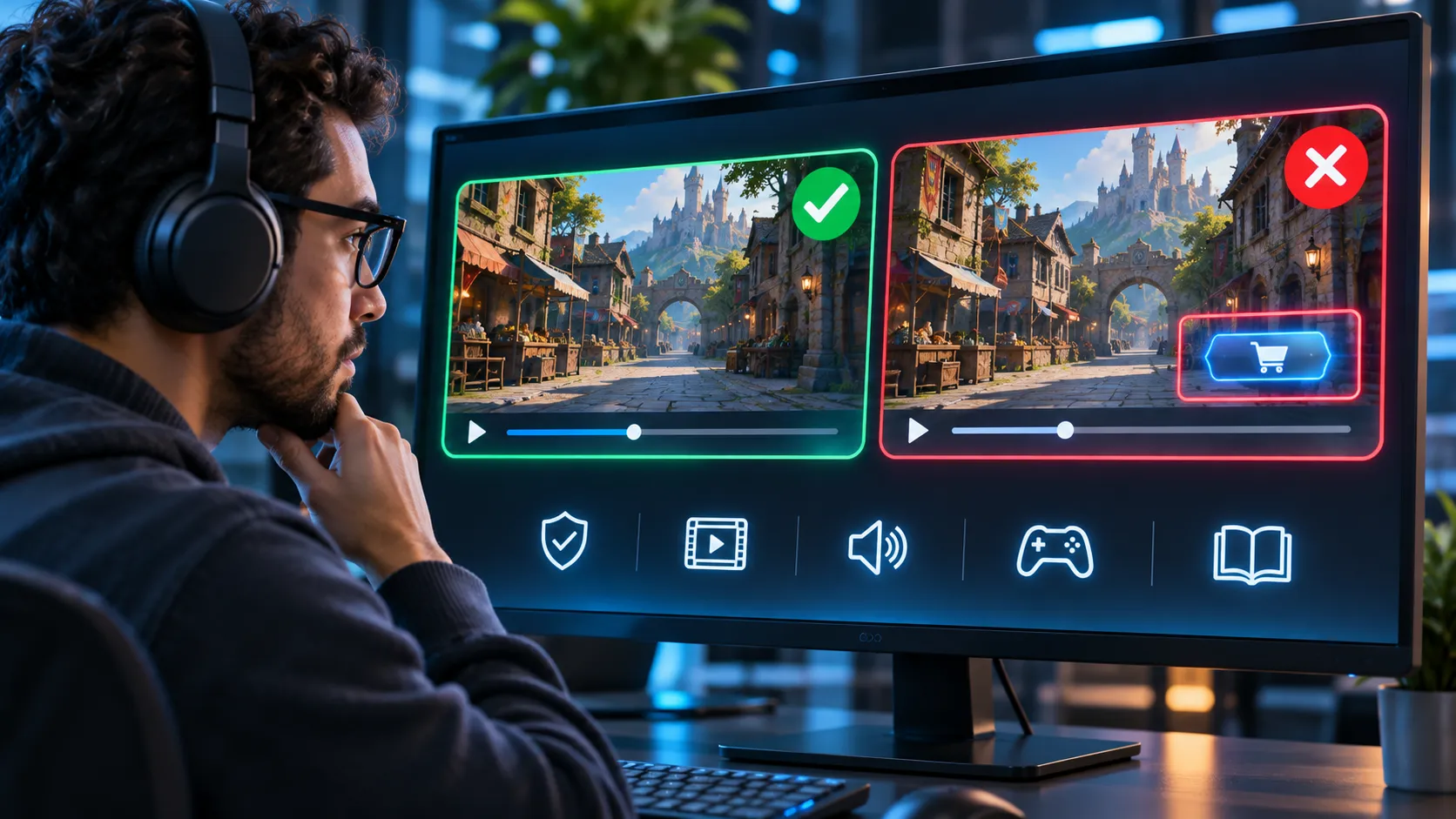
A generated game trailer can be smooth, well scored, and still wrong. A shop sign belongs to a different area of the game. A button appears on screen that the real interface never had. A viewer unfamiliar with the game would watch it and move on. The model's developers cannot afford that, and AI video evaluation exists to catch exactly that kind of error.
Human evaluation is often treated as a transactional step, a pool of reviewers applied to a queue. Our work on a recent generative video project suggests the opposite. Once a model starts producing synthetic worlds, the quality of the evaluation signal depends on operational design: what raters know, how closely related errors are defined, and how fast the team responds when something shifts.
Polish Is Not Fidelity in AI Video Evaluation
Our client builds agentic AI systems that generate synthetic game-world videos. The pipeline combines real game assets, including images, videos and world descriptions, with captured gameplay. It generates scenes independently, stitches them into a sequence and lays AI-generated music over the result. The question was never whether the output looked like a video. It was whether it faithfully represented a specific, real game.
Research on video generation draws the same line. Early benchmark work argued that existing metrics did not fully align with human perception, which is why human preference annotations were used to validate benchmarks (VBench, Huang et al., CVPR 2024). Later work separates superficial faithfulness, meaning whether a video looks visually convincing, from intrinsic faithfulness, meaning whether it adheres to physical laws, commonsense and compositional integrity (VBench-2.0, Zheng et al., arXiv 2503.21755). Automated scores can also diverge from human judgment in practice. One model team reported that its 256p and 512p videos scored similarly on an automatic benchmark but showed a large gap in human win rate (LinGen, arXiv 2412.09856, Appendix C.1).
The errors in a game trailer sit on the second side of that line. A shop sign in the wrong area and a button the interface never had are not rendering flaws. The frame can be clean and the scene still untrue to the game, which is why a score tuned for visual convincingness will not flag them.
Our raters worked on the intrinsic side of that line, assessing five dimensions at once: personally identifiable information, visual quality, audio quality, storyline and accuracy.
Familiarity Comes First
Accuracy was where surface judgment failed fastest. Checking in-video text, numbers, gameplay mechanics, environments and avatar assets requires knowing what the game contains. A rater working from visual inference alone asks whether a scene looks like it belongs in a game. A rater who has walked the environment asks whether it belongs in this one, and can tell when a real storefront has been moved somewhere it never stood.
So we built familiarity into the first production weeks. Raters explored the real game worlds during onboarding and followed client-provided steps for accessing each environment. Before evaluating a trailer for an unfamiliar game, they explored that game first. In our experience on this project, raters who had navigated the actual environments produced more consistent accuracy scores than those relying on visual inference alone. That is our operational observation, not a published finding, but it was strong enough that we now treat exposure to the source material as a prerequisite for accuracy scoring.
Two Errors That Look Alike
The hardest calibration problem was separating two closely related categories:
- Visual hallucination: content generated by the AI with no basis in the real game. Example from the rubric: fake interactive buttons, UI elements that do not exist in the actual game.
- Gameplay inaccuracy: real game elements shown in the wrong context, sequence or configuration. Example from the rubric: real elements in an incorrect arrangement.
Conflating the two produces an unreliable evaluation signal. On screen they land the same way: something the player sees is wrong. For the team improving the pipeline they are different findings. One says the model invented content. The other says it took real assets and put them in the wrong place or order.
Disagreement between annotators is not always noise. Research on subjective annotation tasks shows that annotators can disagree systematically, and that collapsing those disagreements into one label can discard nuance (Davani et al., TACL 2022). That work concerns tasks where disagreement can itself be the signal. Accuracy against a real game sits closer to the other end: a button either exists in the interface or it does not. In a task with closely related categories, some of that disagreement is a guideline problem you can fix.
We treated it as one. We built calibration materials with annotated boundary examples. Each morning, raters and quality leads reviewed newly escalated cases before entering live queues. Ambiguous jobs went into a daily escalation log for client review, and the client's answers were folded back into the calibration materials as a living reference. The morning review meant a boundary call made yesterday was in every rater's head before today's first job, rather than waiting for the next guideline revision. Repeat errors declined as that reference grew.
When the Tool Changes, the Rubric Changes
Midway through the project, the evaluation interface removed its hard-stop response gates. Previously, selecting certain options limited which error types a rater needed to evaluate. Once the gates were gone, the full scope of dimensions opened on every job. Misalignments that had stayed hidden surfaced, and accuracy scores dipped as raters adjusted. The gates had been doing part of the judgment. A rater who had rarely been asked about a given error type in a given context had never had that reading checked, and now it counted on every job.
We now treat a structural tooling change like that as a formal calibration event. It triggered dedicated recalibration sessions, updated reference aids and closer drift monitoring. Quality control ran on two cadences:
- Daily internal audits: quality leads reviewed scored jobs and coached raters below threshold before they returned to live queues. This caught individual rater drift.
- Weekly client reviews: formal QA evaluations gave an external benchmark. This caught systemic gaps in how guidelines were interpreted.
Before any of this, raters had to score at least 80% on project knowledge tests to access a live queue.
What the Numbers Show
Across the project, the team delivered 185,864 structured evaluations. Client-measured accuracy rose from 75.00% at launch to 91.21%, a gain of 16.21 percentage points, and passed the 90% target by week 15. That improvement came alongside guideline updates, an interface change and an expanded evaluation scope. Average handling time was 3 minutes 59 seconds against a 5-minute target.
The Takeaway
Evaluating synthetic worlds will get harder as generation improves, because the remaining errors are the ones that look plausible. Catching them in AI video evaluation depends on raters who know the source material, definitions that hold at the boundaries, and feedback loops measured in days. Those are operational choices, and any team can make them.
If you're evaluating generated video against a real source world, we're happy to compare notes on building a calibrated team for it.
Frequently Asked Questions
What is the difference between visual hallucination and gameplay inaccuracy in AI video evaluation?
A visual hallucination is content the AI generated with no basis in the real game, such as an interactive button the actual interface never had. A gameplay inaccuracy uses real game elements but shows them in the wrong context, sequence or configuration, and conflating the two makes the evaluation signal unreliable.
Why can't automated metrics alone evaluate AI-generated game videos?
Benchmark research has found that automated video metrics do not fully align with human perception, and one model team reported two resolutions with similar automatic scores but a large gap in human win rate. A trailer can also look visually convincing while misrepresenting the real game, a fidelity error that surface-quality scores are not built to catch.
Why should raters explore the source game before scoring accuracy?
Checking in-video text, numbers, gameplay mechanics, environments and avatar assets requires knowing what the game actually contains. On this project, raters who had navigated the real environments produced more consistent accuracy scores than those relying on visual inference alone, an operational observation rather than a published finding.
What should happen when the evaluation tool changes mid-project?
A structural tooling change should be treated as a formal calibration event, with dedicated recalibration sessions, updated reference aids and closer drift monitoring. When this project's interface removed its hard-stop response gates, hidden misalignments surfaced and accuracy dipped until raters adjusted.
What results did this approach produce?
Across 185,864 structured evaluations, client-measured accuracy rose from 75.00% at launch to 91.21% and passed the 90% target by week 15. Average handling time was 3 minutes 59 seconds against a 5-minute target, through guideline updates, an interface change and an expanded scope.