Reinforcement Learning From Human Feedback Defined
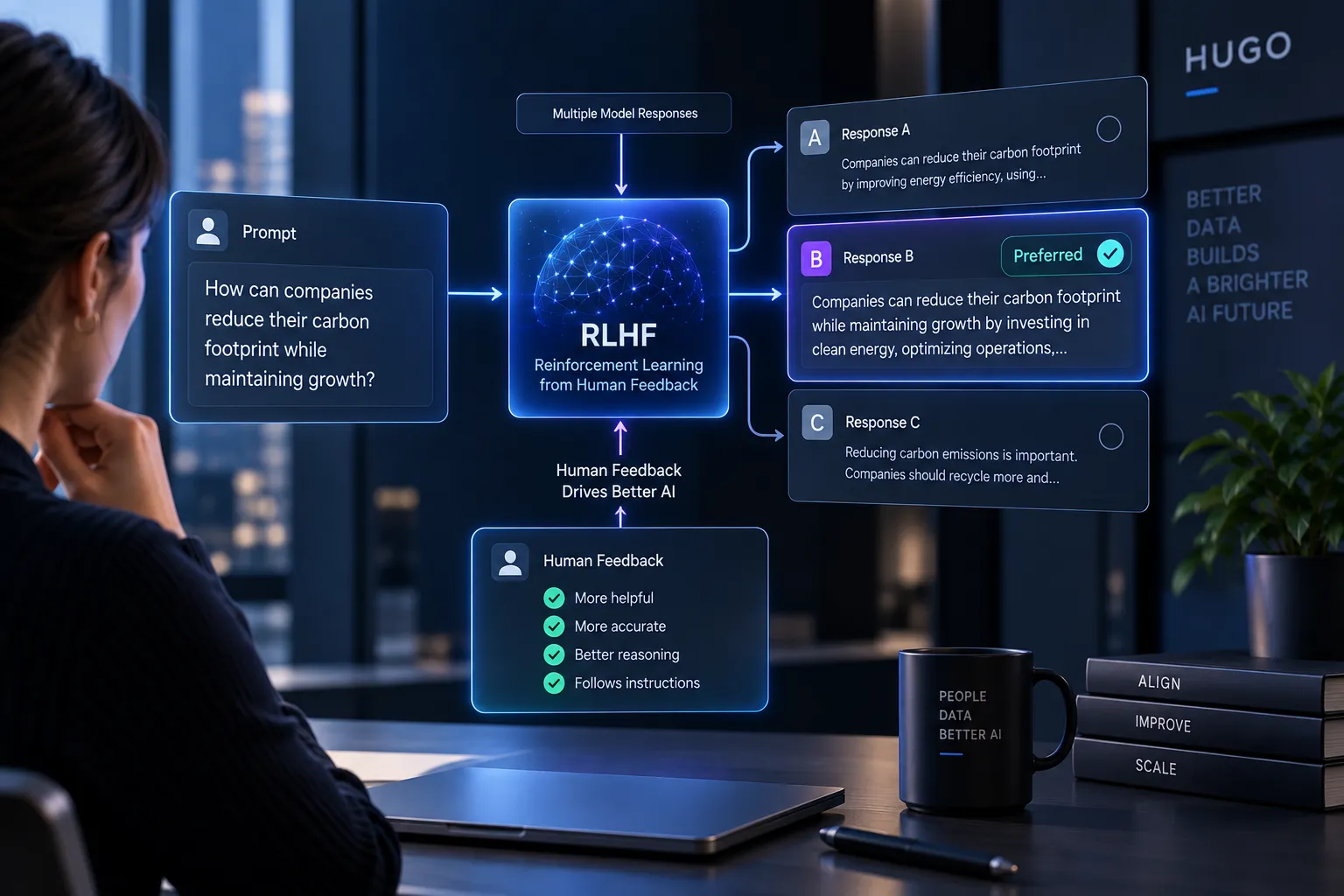
Reinforcement Learning from Human Feedback (RLHF) is a post-training approach that uses human judgments about model outputs to create preference or reward signals that help optimize a model toward desired behavior. A prompt generates multiple model responses, human evaluators assess those responses, and their judgments become a learning signal that guides model optimization.
Reviewers may evaluate correctness, usefulness, instruction following, relevance, safety, reasoning quality, clarity, and style. The specific criteria depend on what behavior the model is supposed to learn.
OpenAI's research on InstructGPT demonstrated how powerful this approach can be. A 1.3-billion-parameter model trained with RLHF outperformed a 175-billion-parameter GPT-3 model on instruction-following tasks. The difference was human feedback quality, not model size.
Where RLHF Fits in Model Development
A simplified conceptual lifecycle: pretraining, then supervised fine-tuning, then human feedback and preference data collection, then optimization, then evaluation. Different teams structure LLM post-training differently, and RLHF may work alongside other alignment methods like DPO or RLAIF. But human preference data remains central to many production alignment workflows.
Human Feedback Can Take Several Forms
"Human feedback" is broader than simply asking whether an answer is good or bad. The format shapes what the model can learn from it.
Pairwise Preference Ranking
A reviewer compares Response A versus Response B and identifies which better satisfies the evaluation criteria. This is one of the clearest examples of preference data, and it powers most RLHF implementations.
Ranking Multiple Responses
Reviewers may order several outputs: best, second best, worst. This provides more granular signal than a single pairwise comparison.
Rubric-Based Scoring
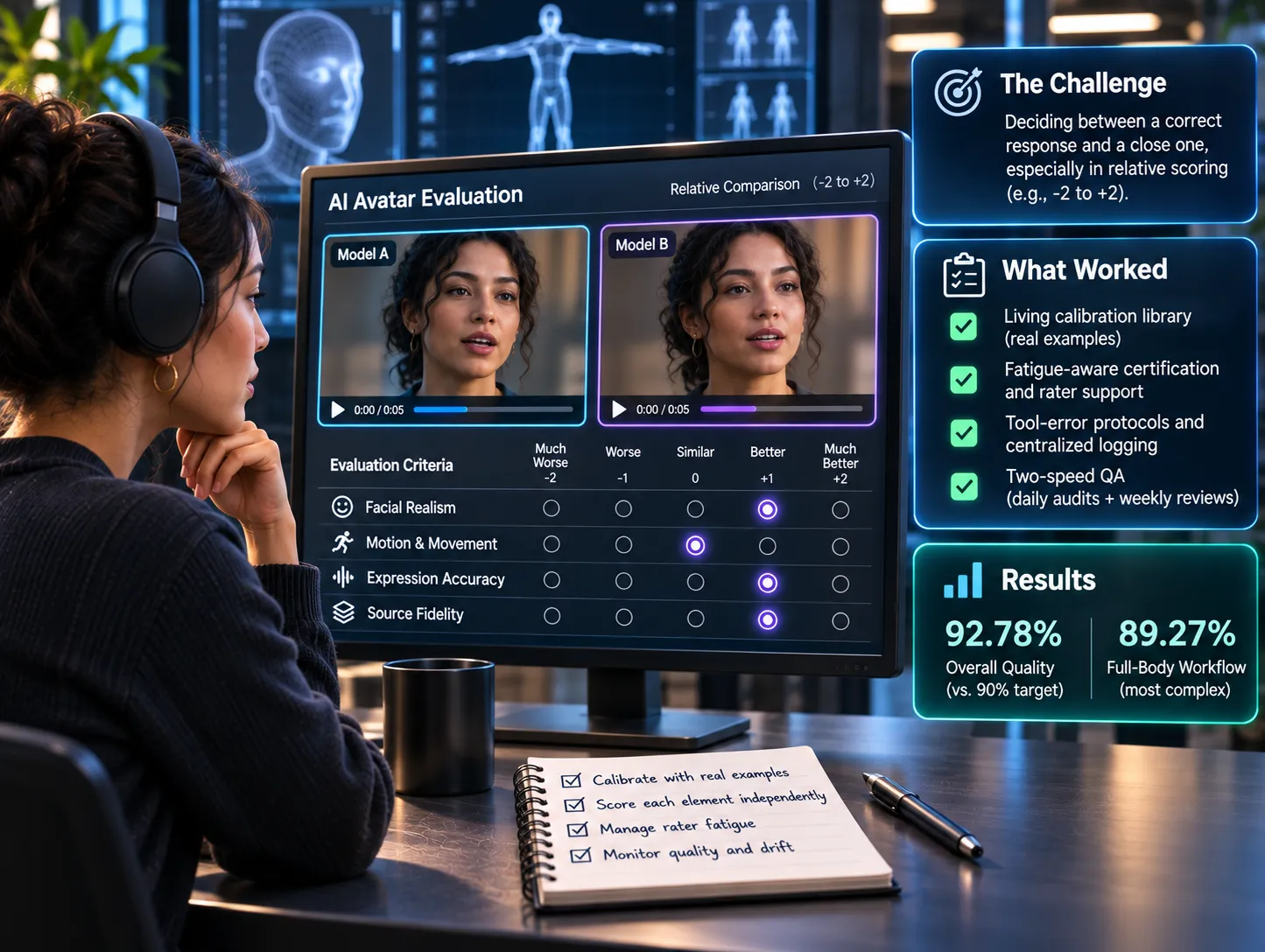
Outputs may be scored against dimensions such as factual correctness, instruction adherence, relevance, safety, or reasoning quality. Teams working on agentic and coding evaluations often use multi-dimensional rubrics because a single preference label cannot capture everything that matters.
Critique or Error Identification
Reviewers may identify factual errors, logical problems, unsupported claims, missed instructions, or safety issues. This feedback can support reward model training or direct remediation.
The Model Learns From the Preference Signal It Receives
This is the central point. RLHF assumes the feedback contains useful information about which model behavior is preferable. If that assumption breaks down, the entire training process breaks down with it.
If the reviewer consistently selects incorrect answers, persuasive but inaccurate responses, or responses that violate the intended rubric, the resulting preference signal can point the model in the wrong direction. The model does not know the human was wrong. It learns to optimize for whatever the human preferred.
Feedback Quality Is More Than Agreement
A team of reviewers can agree with one another and still be wrong. Quality depends on reviewer capability, task understanding, rubric quality, factual correctness, consistency, and calibration.
Research on evaluator characteristics backs this up. A 2025 study on governance challenges in RLHF found that high-rationality evaluators produce 92% consistent feedback, compared to just 45% for low-rationality evaluators. The humans providing the feedback matter enormously.
Who Provides the Feedback Can Be as Important as How Much Feedback Is Collected
Reviewer requirements depend on the task. General evaluation tasks involving writing quality, relevance, or common-knowledge factuality may be handled by well-trained general evaluators.
Specialized evaluation tasks may require expertise in software engineering, mathematics, science, finance, law, or healthcare. Teams building models for frontier and reasoning applications often need reviewers who can verify whether a proof is valid or whether code compiles correctly.
Why Expertise Matters
A response may look convincing to a general reviewer while containing invalid code, incorrect mathematics, or faulty technical reasoning. The evaluator cannot flag what they cannot detect.
As model tasks become more technically demanding, reviewer qualification becomes part of the RLHF data-quality problem. This is why AI data operations increasingly require access to specialized reviewer pools rather than generic annotation workforces.
What Makes a Good RLHF Evaluation Rubric?
An evaluation rubric guides reviewers in judging model outputs consistently. A rubric may define dimensions such as correctness, relevance, completeness, instruction adherence, reasoning quality, safety, and concision.
Define What "Better" Means
Without clear criteria, two reviewers may prioritize different qualities. One may favor shorter answers while another favors more complete answers. Neither is necessarily wrong unless the task defines the priority. And when two responses meet the criteria equally, the accurate call can be a tie: picking the more polished one teaches the reward model the wrong lesson, as one round of The Judgment Call shows.
Avoid Overloaded Rubrics
If reviewers are asked to judge too many poorly defined dimensions, decision quality declines. Simpler rubrics with clear priorities often produce more reliable feedback.
Include Examples and Edge Cases
Strong guidelines show preferred examples, rejected examples, borderline cases, and common evaluator mistakes.
How Do RLHF Teams Keep Human Feedback Consistent?
Reviewer calibration aligns evaluators on how a rubric should be interpreted and applied. Calibration may involve shared evaluation exercises, gold-standard tasks, group review, discussion of disagreements, and retraining.
Measure Inter-Reviewer Agreement Carefully
Agreement metrics can reveal ambiguous guidelines, difficult task categories, and reviewer misunderstandings. But disagreement is not always bad. Some examples are legitimately ambiguous.
Investigate Disagreement Instead of Hiding It
When reviewers disagree, teams should ask: Is the task ambiguous? Is the rubric unclear? Does one reviewer lack necessary expertise?
Reviewer disagreement is often valuable diagnostic data about the evaluation system itself. Teams running comprehensive model evaluations treat disagreement patterns as signals worth investigating.
How Should Human Feedback Data Be Reviewed?
Quality assurance for RLHF data should improve the feedback system continuously. Potential QA mechanisms include:
- Qualification testing: Verify that reviewers can evaluate the task before entering production.
- Gold-standard examples: Use examples with established judgments to detect drift.
- Secondary review: Have difficult or high-value labels checked by another reviewer.
- Expert escalation: Send technically difficult cases to specialists.
- Adjudication: Resolve disagreements through higher-level review.
- Automated checks: Identify missing labels, invalid formats, or suspicious completion patterns.
The continuous loop: review, detect error patterns, clarify the rubric, recalibrate reviewers, continue. This separates production-grade RLHF operations from one-off annotation projects.
Poor Human Feedback Can Create Noisy or Contradictory Learning Signals
When RLHF feedback is low quality, several failure modes emerge.
Contradictory Preferences
Similar outputs receive inconsistent labels. Possible causes include unclear rubrics, evaluator drift, and different expertise levels across the reviewer pool.
Rewarding Style Over Correctness
Reviewers may prefer confidence or fluency even when the response is technically weaker. The model learns to sound right rather than be right.
Systematic Reviewer Bias
Evaluators may repeatedly favor certain patterns unrelated to true task quality. This is why red teaming and alignment work often involves diverse reviewer populations.
Weak Domain Judgment
Reviewers cannot detect subtle technical errors. The model gets rewarded for responses that look correct but are not.
"The hardest part of scaling RLHF is that you're not just scaling annotation, you're scaling judgment. Every new reviewer, every new task type, every model improvement changes what reliable feedback looks like. Teams that treat this as a static data collection problem end up with preference signals that drift away from what they actually wanted the model to learn."
Sean Neighbors, Strategic Accounts Executive
Managed RLHF Requires More Than Adding Reviewers
Scaling preference-data production creates operational challenges: recruiting, reviewer qualification, domain specialization, rubric training, calibration, QA, adjudication, and performance reporting.
Segment Reviewers by Task Difficulty
Not every evaluator needs to review every task. A tiered system may route general tasks to trained evaluators, technical tasks to domain specialists, and disputed cases to senior reviewers.
Monitor Quality as the Workforce Grows
Teams should watch for reviewer drift, disagreement patterns, and rubric confusion. Tasks that were difficult for an earlier model may become trivial for a newer one.
Recalibrate as Models Improve
RLHF data operations should evolve as model capability and failure modes change. Anthropic's work on Constitutional AI involved 135,296 human helpfulness comparisons and 182,831 harmlessness comparisons. Operating at that scale requires infrastructure, not just annotators.
Human Feedback Works Best as Part of an Iterative Process
RLHF does not exist in isolation. The conceptual loop: generate outputs, collect human preferences, QA feedback, optimize model, evaluate, identify new failures, collect better feedback.
RLHF may work alongside SFT, model evaluation, red teaming, process supervision, and AI-assisted evaluation. Evaluations reveal where new human feedback is needed. Those failures become targets for new preference tasks and expert review.
If your team is building RLHF data pipelines and wrestling with calibration, reviewer expertise, or scaling quality assurance, we are happy to compare notes. Explore Hugo's AI data and training services or reach out to talk through what reliable human feedback looks like for your use case.
Frequently Asked Questions
What is RLHF?
Reinforcement Learning from Human Feedback (RLHF) is a post-training approach that uses human judgments about model outputs to help optimize an AI model toward preferred behavior. Reviewers may compare responses, rank alternatives, or score outputs according to criteria such as correctness, helpfulness, instruction following, reasoning quality, or safety.
What type of data is used for RLHF?
RLHF commonly uses human preference data generated by evaluating multiple model outputs. This may include pairwise comparisons, rankings, rubric-based scores, critiques, or other structured judgments that indicate which responses better satisfy the desired evaluation criteria.
Why does human feedback quality matter in RLHF?
Human feedback quality matters because those judgments become part of the learning signal used to optimize model behavior. Inconsistent, inaccurate, or poorly calibrated evaluations can reward undesirable patterns, while reliable feedback requires clear rubrics, appropriately qualified reviewers, calibration, and quality assurance.
How do you improve consistency in RLHF preference ranking?
RLHF preference consistency can be improved through clear evaluation rubrics, reviewer qualification, calibration exercises, shared examples, disagreement analysis, secondary review, and adjudication. Teams should also investigate whether disagreement results from reviewer performance or genuine ambiguity in the underlying evaluation task.
Does RLHF always require domain experts?
No. The required reviewer expertise depends on the task being evaluated. General language or instruction-following tasks may be handled by well-trained evaluators, while advanced coding, mathematics, scientific, legal, or other specialized tasks may require reviewers with relevant domain knowledge.
Can RLHF be outsourced?
Yes. RLHF data operations such as preference ranking, human evaluation, calibration, and quality assurance can be supported by external managed teams. Organizations should evaluate whether a provider can source appropriate reviewers, maintain consistent rubrics, manage QA and adjudication, and scale feedback without reducing reliability.