The hardest part of deploying an AI agent is rarely the agent itself. In enterprise AI agent deployment, it is everything around it: defining the work, teaching the system how an organization operates, keeping people in control where the stakes are high, and measuring whether the output is actually good.
A recent first-hand account of building an AI agent for ServiceNow offered a useful reminder of this. The team expected its biggest challenges to be broad and technically complex. Instead, the highest-value opportunities were narrower and more repetitive than its roadmap assumed. Its advice was to begin with a single workflow: rules-based, high-volume, easy to measure, and easy to reverse.
That lesson applies far beyond one platform or vendor. It describes a pattern emerging across enterprise AI: the models are becoming capable quickly, but reliable deployment still depends on human judgment.
Narrow scope makes quality measurable
A broad agent is difficult to evaluate because "correct" is ambiguous. A narrow workflow gives teams a definition of success.
The strongest first use cases tend to share a few traits:
- They have a limited set of inputs and outputs.
- They follow recognizable rules or conventions.
- They occur often enough to justify automation.
- Their actions can be reviewed, tested, or reversed.
Scoping is therefore not just a product decision. It is a quality decision. If a team cannot define what a good outcome looks like, it cannot reliably measure performance, diagnose failures, or improve the system.
The cost of skipping that step shows up in the forecasts. Gartner predicts that over 40% of agentic AI projects will be canceled by the end of 2027, citing escalating costs, unclear business value, or inadequate risk controls. Each of those is a scoping and control problem as much as a technical one.
Human approval is a design feature
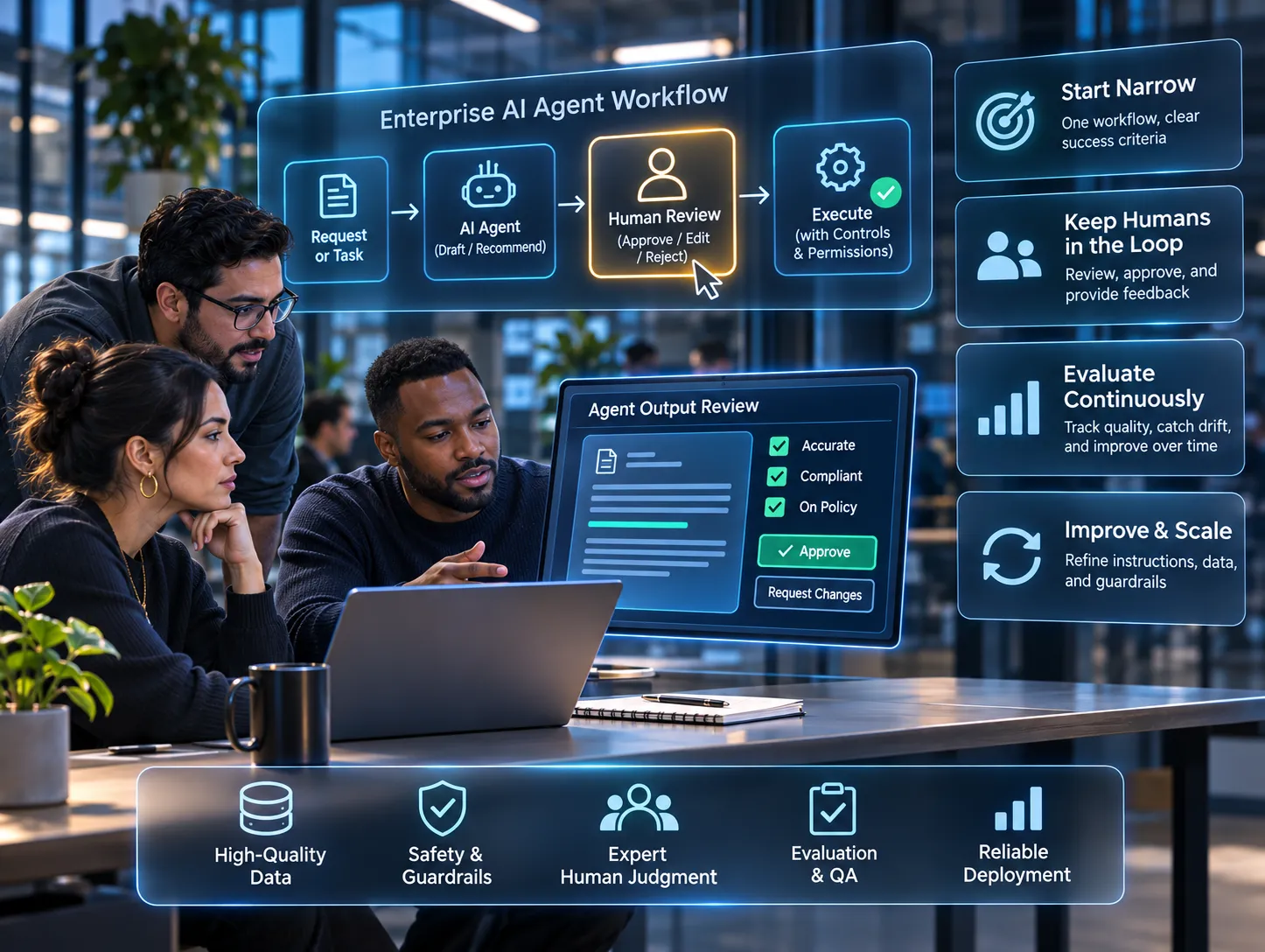
In the ServiceNow deployment referenced above, people reviewed and approved actions that changed data before those actions ran, and the agent worked through the user's own ServiceNow identity and permissions. That control was not a limitation to engineer away. It was what made the system acceptable to deploy.
This pattern is common in enterprise settings. AI can draft, classify, recommend, and prepare actions, while people retain authority over consequential decisions. That division of labor is not a temporary compromise; it is often the foundation of trust.
Rising capability does not change that on its own. METR has found that the length of tasks frontier agents can complete autonomously has doubled roughly every seven months for about six years, but that measure is set at 50% reliability. An agent that finishes a task half the time is improving fast. It is not an agent a business should let change records unreviewed.
Human review also creates operational signal. Every approval, correction, rejection, and escalation shows where the system is dependable and where it needs better instructions, better data, or stronger guardrails. Rejections that cluster on one request type point to a gap in instructions. Repeated corrections to the same field point to a data or formatting problem.
Agents must learn how an organization works
A model may understand language, but it does not automatically understand an organization's standards: how documents should be structured, how records should be named, which exceptions matter, or when an action should escalate to a person. One round of The Judgment Call, triaging an insurance claim, turns on exactly that.
That knowledge has to be made explicit. It comes from policies, examples, annotations, edge cases, and feedback from people who understand the work. Specialized AI behavior depends on this carefully prepared human input. The ServiceNow team ran into exactly this: one of the things that proved harder than expected was teaching the agent to read the organization's requirements format reliably.
In practice, building an enterprise agent often resembles onboarding a new employee more than configuring software. The system needs context, standards, examples, and feedback loops, not just access to tools.
Evaluation cannot stop at launch
Enterprise AI teams need to know what an agent did, whether it worked, and what it cost. But evaluation cannot end at launch.
Models change. Data shifts. Policies evolve. Edge cases appear. A workflow that performed well in a pilot can degrade in production unless teams continue to test it against real-world conditions.
Research on conventional machine learning models has a name for one version of this. A 2022 study in Scientific Reports described "AI aging": model quality degrades as time passes since the last training cycle, and drift in the underlying data alone does not explain it. Agents add more moving parts on top of that, including prompts, tools, permissions, and the policies they are meant to follow.
That requires people who can judge outputs consistently: identifying failures, labeling difficult cases, probing for unsafe behavior, and translating those findings into better instructions, datasets, and safeguards. NIST's Generative AI Profile (AI 600-1) treats this work the same way, listing post-deployment monitoring, regular review of guardrails, documented human oversight, and red-teaming among its expected practices.
The human layer is infrastructure
The most durable AI systems will not be the ones with the fewest humans involved. They will be the ones with the right humans involved at the right points.
AI teams need people to define quality, create representative evaluation data, review high-risk outputs, test adversarial behavior, and maintain standards as the system changes. This work is easy to underestimate because it is less visible than the agent itself, but it is what turns an impressive demo into a dependable product.
Where Hugo fits
Hugo supports AI teams building this human layer. We help organizations turn ambiguous real-world cases into clear evaluation criteria, high-quality labeled data, red-team scenarios, and actionable Trust and Safety findings.
Our focus is not replacing human judgment with automation. It is making human judgment scalable, consistent, and usable across the AI development lifecycle.
The takeaway for enterprise AI agent deployment
For any enterprise AI agent deployment, start with one narrow, measurable workflow. Define correctness before automating. Keep people in control where errors are costly. Then invest continuously in the evaluation, data quality, and safety work that keeps the system reliable after launch.
The agent may be the visible part of the system. The human judgment behind it is what makes it trustworthy.
Frequently Asked Questions
What is the hardest part of enterprise AI agent deployment?
The hardest part is rarely the agent itself. It is defining the work, teaching the system how the organization operates, keeping people in control where the stakes are high, and measuring whether the output is actually good.
Why should an enterprise AI agent start with a narrow workflow?
A narrow workflow gives teams a definition of success, so they can measure performance, diagnose failures, and improve the system. The strongest first use cases have limited inputs and outputs, follow recognizable rules, occur often, and produce actions that can be reviewed, tested, or reversed.
Should humans approve the actions an AI agent takes?
Where errors are costly, yes: human approval of consequential actions, such as changes to data, is a design feature that makes the system acceptable to deploy, not a limitation to engineer away. Every approval, correction, rejection, and escalation also shows where the agent is dependable and where it needs better instructions, data, or guardrails.
How does an AI agent learn an organization's standards?
It does not learn them automatically; standards such as document structure, record naming, which exceptions matter, and when to escalate have to be made explicit. That knowledge comes from policies, examples, annotations, edge cases, and feedback from people who understand the work, much like onboarding a new employee.
Why does AI agent evaluation need to continue after launch?
Models change, data shifts, policies evolve, and new edge cases appear, so a workflow that performed well in a pilot can degrade in production. Ongoing evaluation needs people who can judge outputs consistently and turn what they find into better instructions, datasets, and safeguards.