SWE-Bench Tests AI Systems on Real Software Engineering Tasks
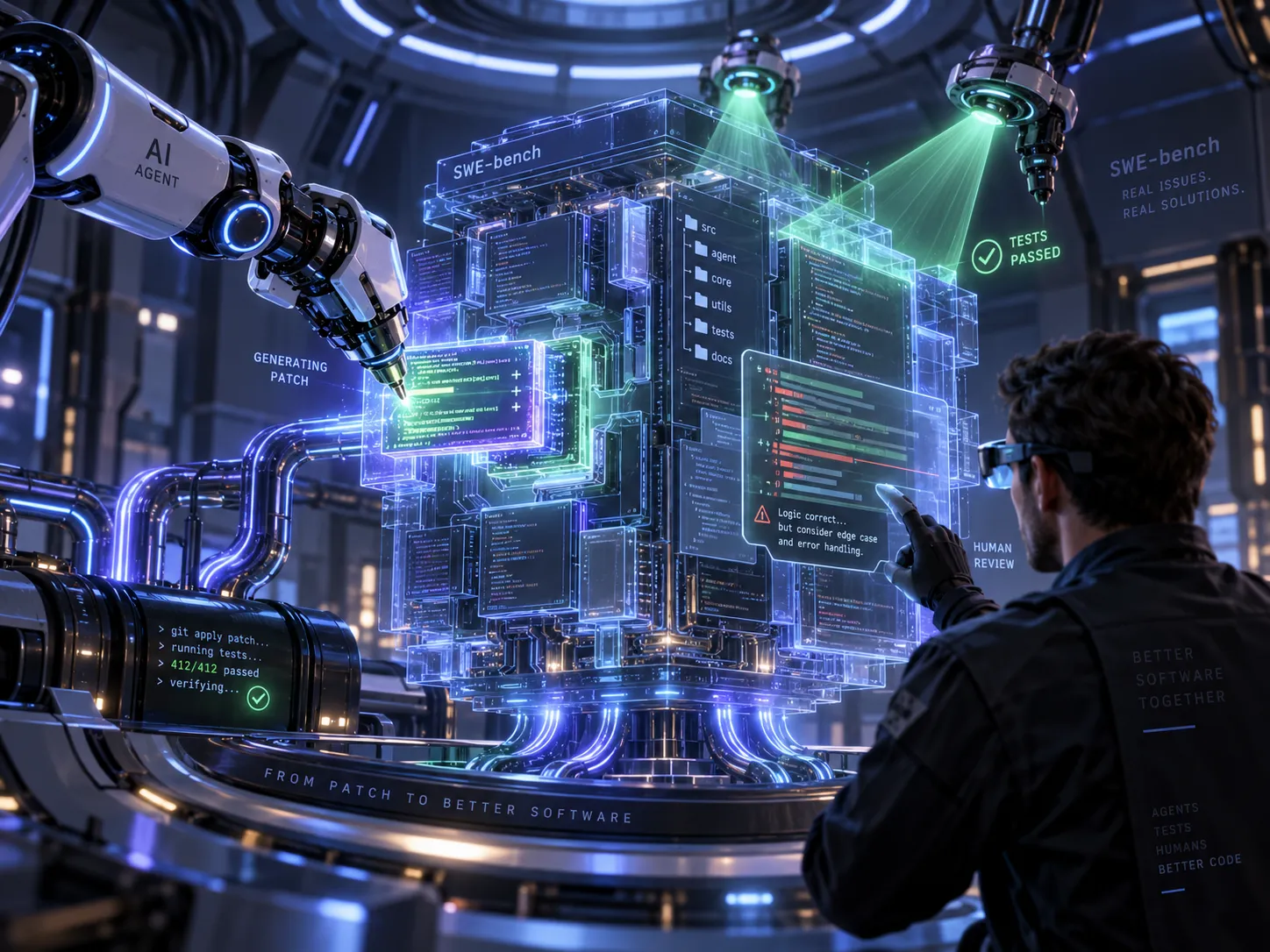
SWE-bench is a benchmark for evaluating AI systems on real-world software-engineering issues collected from GitHub. The benchmark contains 2,294 software engineering problems drawn from 12 popular Python repositories, with tasks that require models to understand and coordinate changes across multiple functions, classes, and files simultaneously.
The workflow is straightforward: given a repository and an issue, the system must generate code changes intended to resolve the problem. The resulting patch is evaluated using repository tests in isolated Docker environments. The benchmark does not simply ask whether generated code looks reasonable. It asks whether the code actually works.
SWE-Bench Verified Adds Human Validation to the Benchmark Itself
SWE-bench Verified is a human-validated subset of 500 SWE-bench instances. Engineers reviewed tasks to ensure problem descriptions are clear, test patches are correct, and tasks are solvable from the available information. Human judgment already plays an important role in making software-engineering benchmarks themselves more reliable.
Coding Agents Do More Than Generate a Final Patch
A coding agent operating on a SWE-bench task may need to read the issue, inspect the repository, locate relevant files, search symbols, form a hypothesis, edit code, run tests, inspect errors, revise the implementation, and produce the final patch. This sequence creates a trajectory containing evaluation data that extends well beyond whether the final patch passes or fails.
The Trajectory Contains Useful Evaluation Data
Inspectable artifacts include file reads, repository searches, terminal commands, code edits, test executions, error messages, retries, and the final patch. Two agents can generate similarly successful patches while following dramatically different trajectories.
One agent might locate the correct file immediately, make a targeted change, and verify it in two test runs. Another might search a dozen irrelevant directories, make several incorrect edits, and stumble into a passing solution after many retries. Both pass. But they demonstrate very different levels of software-engineering reasoning. Agentic coding evaluations can examine the process as well as the final artifact.
Agents Need an Environment Where Their Code Can Actually Be Tested
A coding agent may need to edit files, execute shell commands, install dependencies, run tests, and maintain temporary workspace state. Isolated sandboxed environments allow those behaviors to be evaluated without granting uncontrolled access to production systems.
SWE-bench applies generated patches to real-world repositories and runs the test suite in containerized Docker environments. E2B sandboxes provide another option, offering isolated environments for code execution and terminal commands. Environment state matters: evaluators need to know the repository version, dependencies, available tools, and permissions. A test that fails because of a missing dependency is not the same as a test that fails because of incorrect agent reasoning.
Tests Answer Whether the Patch Works Against Defined Requirements
Automated tests are essential because they provide objective verification. They can reveal regression failures, incorrect behavior, missing functionality, and edge-case failures. This is not a limitation. Executable verification is the foundation of any serious software-engineering evaluation.
Passing Tests Does Not Answer Every Evaluation Question
A passing patch may still modify unrelated code, introduce questionable implementation choices, contain unnecessary changes, or reach success through an inefficient trajectory. The test suite verifies functional requirements. It does not evaluate whether the implementation represents sound engineering judgment.
Failing Tests Can Also Be Ambiguous
A failed task may result from incorrect implementation, misunderstood requirements, environment failure, flawed tests, or ambiguous benchmark instructions. Understanding why something failed often requires looking beyond the pass/fail result. Executable tests should remain the primary functional signal, while human review supplies diagnostic context.
Technical Review Goes Beyond Whether Tests Turn Green
Human engineering evaluators can inspect whether the agent correctly understood repository architecture, relevant modules, dependencies, and the scope of the requested change.
Repository Navigation
Did the agent locate the relevant files? Did it understand dependencies before editing? Repeatedly searching irrelevant parts of the repository may indicate weak software-engineering reasoning, even if the agent eventually produces a correct patch.
Scope of the Patch
Reviewers can assess whether changes are appropriately targeted, unnecessarily broad, or likely to introduce maintenance problems. A patch that modifies dozens of files to fix a single-function bug raises questions that a simple pass/fail score cannot capture.
Technical Plausibility
A patch can satisfy existing tests while still raising questions about edge cases, maintainability, or repository conventions. Human review can distinguish a robust implementation from one that happens to satisfy the available tests.
"When we evaluate coding agents, the pass/fail result is table stakes. The real question is whether the agent demonstrated the kind of reasoning you'd want from an engineer on your team, or whether it just got lucky. That distinction matters for deciding which model improvements actually move the needle."
Sean Neighbors, Strategic Accounts Executive
Strong Coding Agents Need to Respond Intelligently When the First Attempt Fails
Most realistic software-engineering tasks require iteration. Human reviewers can evaluate error recognition, root-cause analysis, revision quality, test selection, and whether the agent kept making the same mistake.
Successful Recovery Is Different From Random Retrying
An agent may eventually pass after many arbitrary edits. Another may inspect the error, identify the root cause, make one targeted correction, and verify the fix. Both eventually pass, but the second demonstrates stronger debugging behavior. This is one reason frontier and reasoning labs often want trajectory-level data alongside benchmark scores.
Sometimes the Benchmark or Environment Is the Problem
A coding task may fail even if the agent's behavior is reasonable. Potential causes include ambiguous issue descriptions, incomplete test coverage, incorrect tests, and environment configuration problems. SWE-bench Verified itself demonstrates the importance of this distinction: its human-validation process filtered tasks based on clarity, test correctness, and solvability.
Humans Can Identify Legitimate Alternative Solutions
The agent's patch may differ substantially from the original developer fix while still solving the problem. A different approach is not automatically a wrong approach.
Humans Can Flag Benchmark Quality Problems
Reviewers may identify impossible tasks, unclear acceptance criteria, or broken environments. Reliable agent evaluation also requires evaluating the evaluation task itself. This is why data engineering around evaluation infrastructure matters as much as the evaluators themselves.
Human Evaluators Can Classify Coding-Agent Failure Modes
Rather than recording only PASS or FAIL, human review can identify failure categories: repository understanding failure, planning failure, tool-use failure, implementation failure, debugging failure, verification failure, environment failure, and benchmark failure. This creates much richer diagnostic data than binary outcomes.
Error Taxonomies Enable Aggregate Analysis
Teams can ask: Which failures occur most often? Does the model struggle with navigation or implementation? Is debugging improving between model versions? Trajectory annotation transforms benchmark scores into actionable model-development data. This kind of structured feedback can inform post-training improvements and help teams prioritize where to invest.
The Best Coding Evaluations Combine Objective Verification With Technical Judgment
This is not a choice between automation and humans. Automated evaluation is strong for test execution, code compilation, deterministic checks, and large-scale benchmark runs. Human evaluation is strong for ambiguous outcomes, trajectory interpretation, implementation quality, debugging behavior, and root-cause analysis.
Route Only the Right Cases to Humans
Human review does not necessarily need to inspect every trivial successful run. Teams might prioritize unusual passes, unexplained failures, benchmark disagreements, and technically complex trajectories. Human-in-the-loop code evaluation works best when automated verification handles objective checks and technical reviewers focus on questions automation cannot answer reliably.
What to Look for in a SWE-Bench Evaluation Workforce
Technical evaluation requires more than general annotation experience. Useful capabilities include software-engineering expertise, Python and repository navigation, Git familiarity, terminal usage, debugging, test interpretation, sandbox experience, and trajectory review.
Research on AI code review adoption shows how important human oversight remains. AI agents' code suggestions are adopted into codebases at 16.6% compared to 56.5% for human reviewers, with over half of unadopted AI agent suggestions being either incorrect or addressed through alternative developer fixes.
Evaluators Should Be Able to Work Inside the Environment
A technical reviewer may need to inspect repository files, understand the issue, read patches, run commands, reproduce tests, and inspect failures. This is fundamentally different from simple text preference labeling. High-quality training data for coding models requires evaluators who can actually execute and verify code.
Build Evaluation Rubrics Around Engineering Questions
Possible dimensions include issue understanding, repository navigation, implementation correctness, patch scope, debugging quality, and task completion. The rubric should reflect what good software engineering looks like, not just what passes a test. Technically difficult tasks may require senior engineers, specialist escalation, and adjudication.
Add Engineering Judgment to Agentic Coding Evaluation
If your team is building or evaluating coding agents and needs technical reviewers who can work inside sandboxed environments, inspect full trajectories, debug failures, and distinguish agent errors from benchmark problems, we're happy to compare notes. Hugo works with frontier AI labs on exactly these kinds of agentic coding evaluations.
SWE-Bench and Agentic Coding Evaluation FAQs
What is SWE-bench evaluation?
SWE-bench evaluation tests whether AI systems can resolve real-world software-engineering issues by modifying code repositories and producing patches that satisfy defined tests. The benchmark uses executable repository environments, allowing coding systems to be evaluated on functional software changes rather than code generation alone.
Why is human review useful for SWE-bench evaluation?
Human review can explain why a coding agent passed or failed when automated tests alone provide limited diagnostic information. Technical evaluators can examine repository navigation, patches, test execution, debugging behavior, environment failures, ambiguous tasks, and other elements of the full coding-agent trajectory.
What is SWE-bench Verified?
SWE-bench Verified is a human-validated subset of 500 SWE-bench instances designed to improve benchmark reliability. Engineers reviewed tasks to verify factors including problem clarity, test correctness, and whether the issue was solvable from the available information.
What does a human evaluator review in an agentic coding trajectory?
A technical evaluator may review repository searches, files inspected, terminal commands, code changes, test results, debugging steps, retries, and the final patch. This can reveal whether the agent understood the task, used the environment appropriately, recovered from errors, and reached the result through a technically sound process.
Can a coding agent pass tests and still have a poor trajectory?
Yes. A coding agent can produce a patch that passes defined tests despite unnecessary edits, incorrect intermediate assumptions, excessive retries, or brittle implementation decisions. Functional success remains important, but trajectory review provides additional information about reliability and engineering behavior.
Should human evaluation replace automated coding benchmarks?
No. Human review should complement rather than replace automated functional verification. Executable tests provide scalable, objective evidence that code satisfies defined requirements, while human technical reviewers can interpret ambiguous results, diagnose failure causes, evaluate trajectories, and identify problems with the benchmark or environment itself.