The Client
A global Technology company developing advanced AI systems needed to improve the accuracy and scalability of object-centric 3D reconstruction from single 2D images.
The reconstruction pipeline transforms a single 2D image into a coherent 3D scene by isolating key objects, modeling their geometry, and predicting their poses and positions. These reconstructed layouts support the Client’s broader work in immersive AI and generative 3D content.
Hugo was engaged to provide the specialized human judgment needed to execute four interconnected workflows at scale, with a focus on high-quality object segmentation, mesh selection, spatial alignment, and scene evaluation, in which errors at one stage could degrade downstream reconstruction quality.
Partnership at a Glance
- Operational Scope: Four interconnected workflows spanning object segmentation, mesh recognition and retrieval, spatial alignment, and full-scene evaluation.
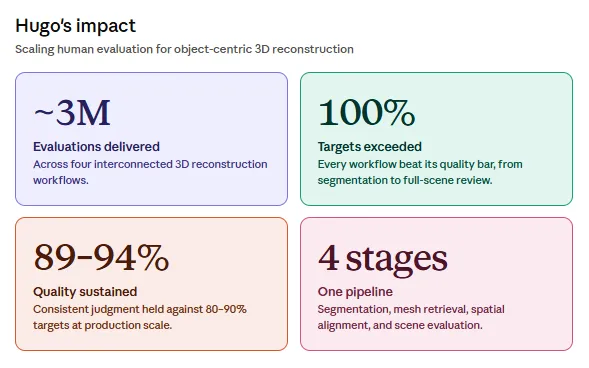
- Scale: ~3M evaluations delivered across the four workflows.
- Quality: 89%–94% quality performance across tasks, exceeding the Client's targets for every workflow.
- Technical Complexity: High-judgment visual and spatial reasoning across occluded objects, ambiguous boundaries, imperfect meshes, and 3D positioning.
- Specialized Expertise: Specialists pre-screened for logic and spatial reasoning, with engineering and 3D modeling backgrounds valued for high-judgment tasks.
- Quality Model: Continuous calibration and Trace-Level Convergence Auditing to align judgment, resolve edge cases, and maintain consistency as evaluation criteria evolved
The Challenge
Object-centric 3D reconstruction depended on accurate decisions at every stage of the pipeline. Segmentation, mesh selection, spatial alignment, and scene evaluation could not be treated as isolated tasks because errors introduced early in the workflow directly affected the quality of the final reconstruction.
- Visual ambiguity complicated segmentation: Occlusion, clutter, and incomplete object boundaries made reconstructable objects difficult to identify consistently.
- Mesh selection required spatial judgment: Specialists often had to choose between imperfect 3D representations, balancing geometry, proportion, and appearance.
- Spatial alignment demanded precision: Meshes had to be positioned realistically while preserving depth, orientation, and relationships between objects.
- Evaluation criteria evolved throughout production: New edge cases required continuous adaptation without introducing inconsistent judgment.
- Errors compounded across the pipeline: An incorrect segmentation could lead to the wrong mesh, unstable alignment, and ultimately a less reliable reconstructed scene.
To support these interconnected workflows, the Client engaged Hugo to provide specialized human judgment capable of maintaining consistent quality across the entire reconstruction pipeline.
The Solution
Hugo built a structured human-in-the-loop workflow around specialized spatial reasoning, systematic evaluation, and continuous calibration.
AI Alignment Specialists
Hugo selected specialists for strong logic, visual reasoning, and spatial perception. Prior engineering and 3D modeling knowledge proved particularly valuable for work that required interpreting 2D information in three-dimensional space.
Rather than treating each evaluation as an isolated judgment, specialists followed repeatable methods for refining object boundaries, comparing candidate meshes, and assessing spatial placement from multiple viewpoints.
Systematic Evaluation Across the Reconstruction Pipeline
Each stage followed a defined evaluation approach:
- Object segmentation: Masks were progressively refined around complex boundaries, including thin structures, curved edges, and occluded areas.
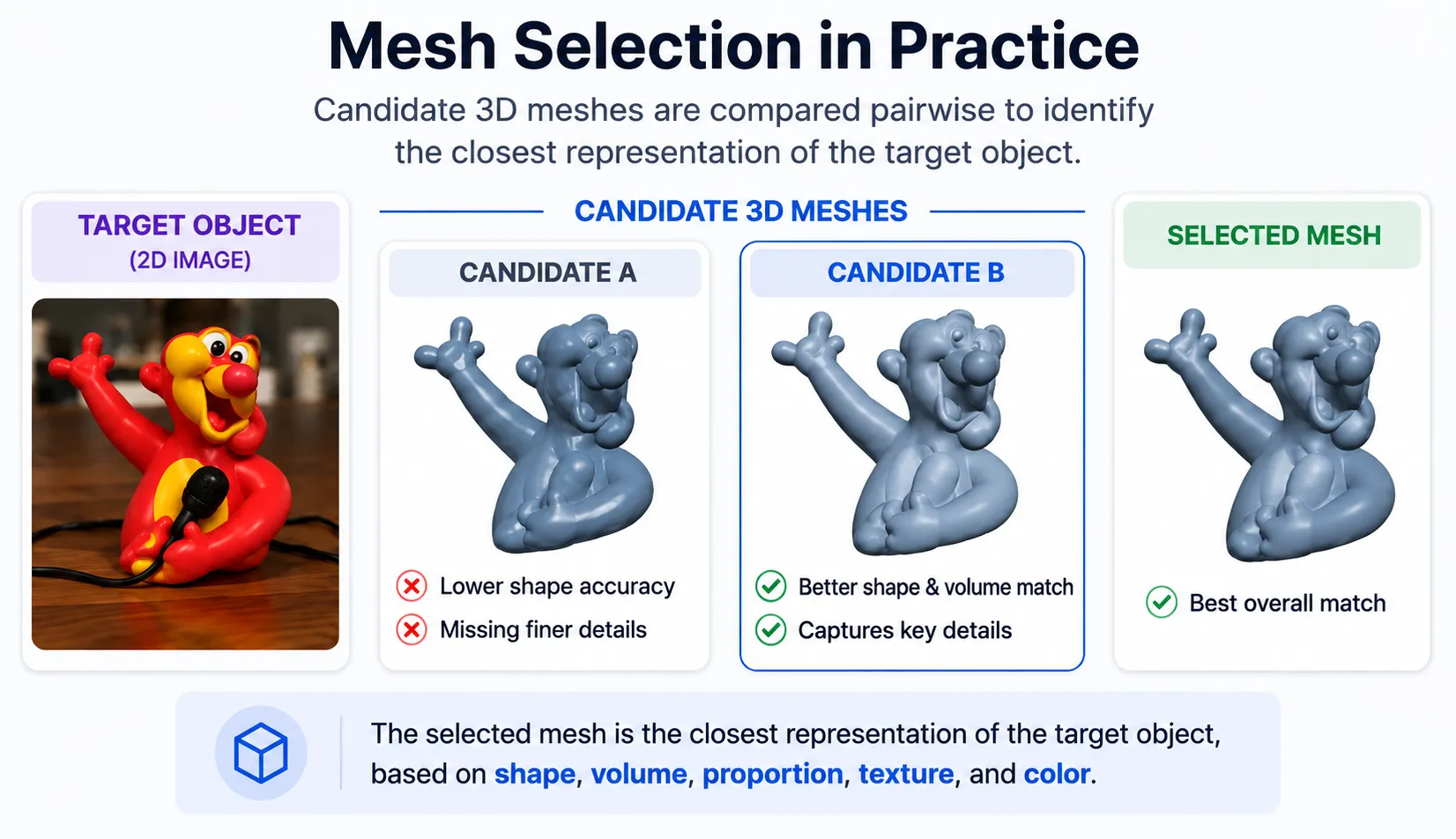
- Mesh selection: Candidate meshes were compared pairwise to assess differences in shape, volume, proportion, texture, and color and identify the closest representation. Spatial alignment: Positioned meshes were viewed from multiple angles to assess depth, rotation, orientation, and ground-plane contact.
- Scene evaluation: Complete scenes were reviewed for floating objects, misalignment, and unrealistic interactions to ensure a coherent reconstruction.
Continuous Calibration and Trace-Level Convergence Auditing
As edge cases surfaced and evaluation criteria evolved, Hugo used continuous calibration to keep specialist judgment aligned.
Trace-Level Convergence Auditing provided an additional review layer, supported by:
- Calibration sessions to resolve ambiguous cases and inconsistencies.
- Shared decision references to maintain consistency around partial captures, object validity, mesh selection, and acceptable spatial alignment.
- Ongoing rubric refinement informed by recurring patterns and edge cases identified during production.
The Results
Hugo scaled the workflow to approximately 3 million evaluations across four interconnected 3D reconstruction tasks, exceeding the Client’s quality target across every workflow.
| Workflow | Quality Achieved | Target | Volume Delivered |
|---|---|---|---|
| Object Segmentation | 91.20% | 80% | 302,554 |
| Mesh Recognition & Retrieval | 89.31% | 80% | 2,138,481 |
| Spatial Alignment | 90.46% | 80% | 459,259 |
| Scene Evaluation | 93.97% | 90% | 81,346 |
Beyond volume and quality performance, continuous calibration established clearer criteria for edge cases, partial captures, standalone versus full-object meshes, and acceptable spatial alignment.
Conclusion
Object-centric 3D reconstruction is only as reliable as the decisions connecting each stage of the pipeline. By bringing structured human judgment to these interconnected workflows, Hugo created a more consistent, scalable evaluation framework for producing spatially coherent 3D reconstruction data.
“The complexity of this work required consistent judgment across every stage of the pipeline. Hugo’s team adapted quickly as requirements evolved, and maintained strong quality even as we scaled.”
— Technical Program Manager, AI, the Client