Image-editing models are judged on something harder to pin down than a right answer. An edit can follow the instruction exactly and still look wrong. It can look beautiful and still have quietly changed a person's face. Grading that reliably, at volume, is a human judgment problem before it is a tooling problem.
Hugo was engaged to evaluate outputs from a photo-editing model that transforms user images from natural-language prompts. Over ten weeks our team completed 276,565 annotations at a quality score of 88.31% against an 80% target. This is how the work was structured.
What We Were Asked to Measure
Evaluation ran across six dimensions, each isolating a different way an edit can succeed or fail:
- Instruction adherence. Does the output faithfully represent the subject, style, composition and detail the prompt specified?
- Visual transformation accuracy. Does the model change the aesthetic while holding the composition steady? Turning a photo into a cartoon while keeping the same character.
- Visual appeal. Is the result clean, expressive and well rendered, judged on lighting, colour, realism and visual harmony?
- Photo-realism. Do skin, hair and expression read as lifelike rather than plastic or overly smoothed?
- Safety and integrity. Does the prompt or output carry harmful, NSFW or biased content?
- Image composition. Are subject placement, cropping, pose and spatial relationships balanced?
Why It Was Hard
Every job required multimodal reasoning across the visual content and the transformation instruction at the same time. Five things made that difficult.
1. Visual transformation assessment
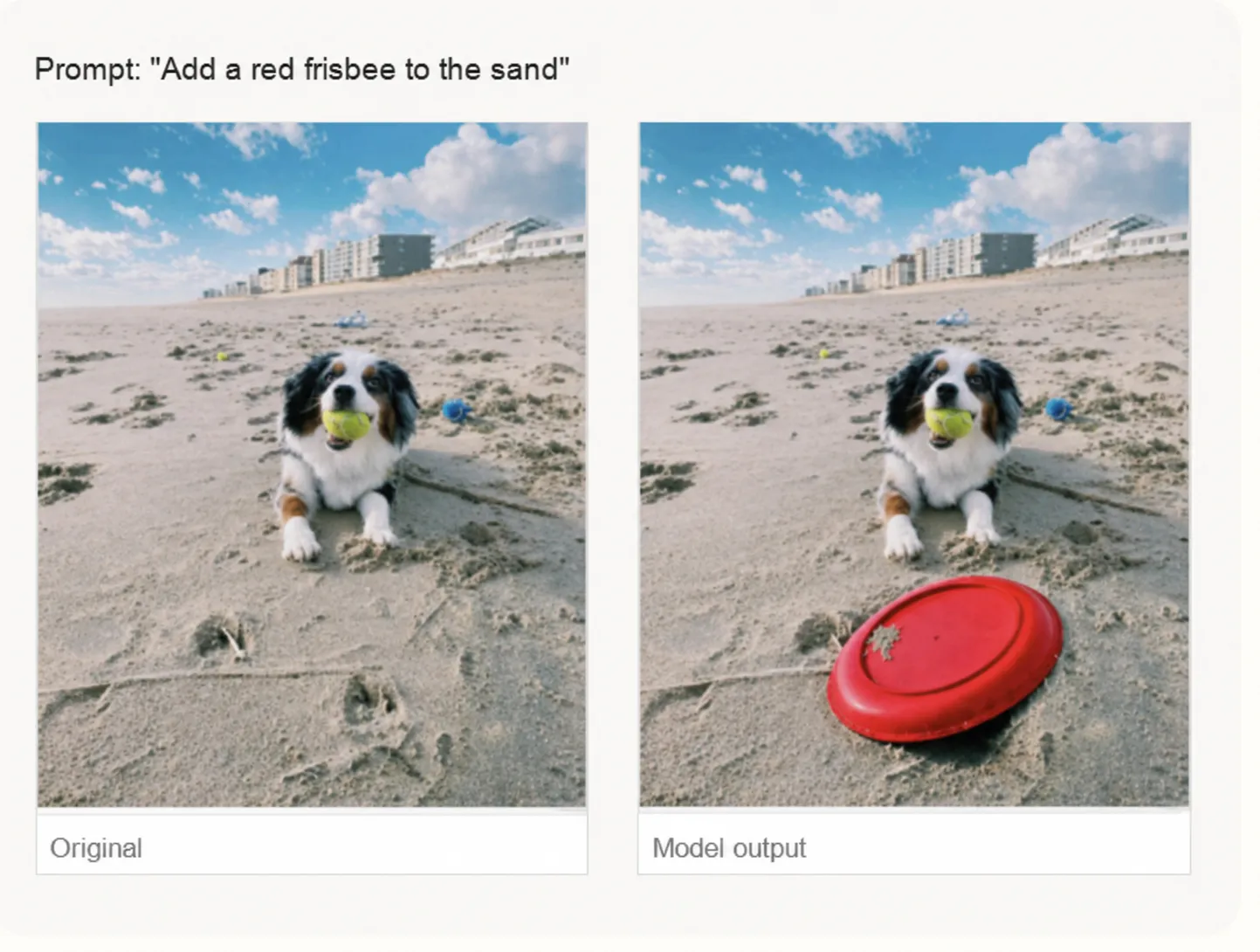
Raters had to decide three things at once: whether the edit matched the instruction, whether the transformation looked realistic, and whether the important visual elements survived it. When a model gets this right, the judgment is quick.
2. Safety and integrity risks
A separate review pass flagged unsafe or sensitive transformations, over-modified or distorted images, alterations that misrepresented identities, and edits that violated policy. The hardest cases were not the obviously prohibited ones. They were prompts that seemed benign and produced outputs that were offensive through distortion or illogical placement, particularly when the edit introduced people into a scene. Those needed a human to catch, because nothing in the instruction predicted the failure.
3. Realism and quality judgment
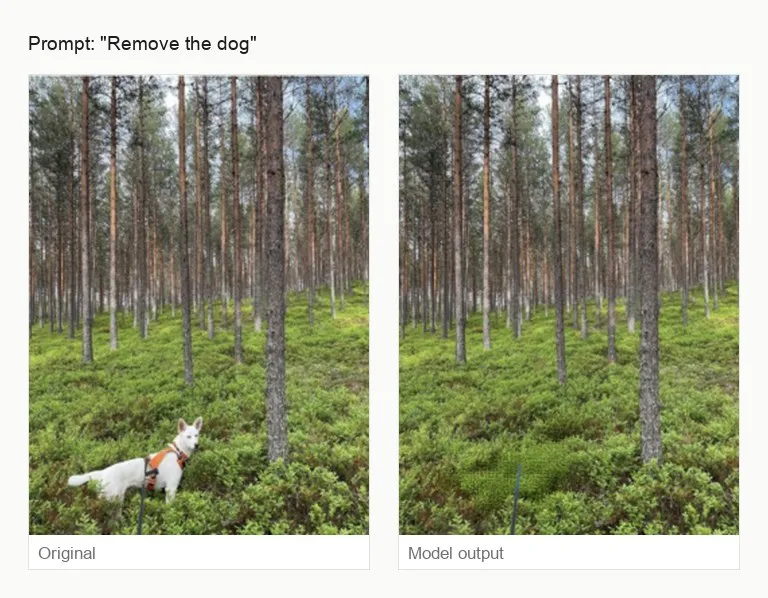
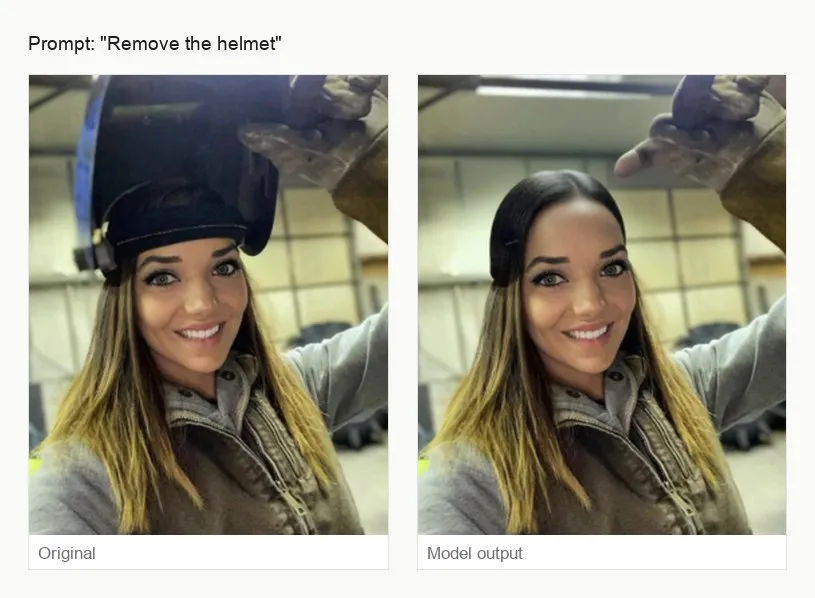
Output quality varied from subtle and high-fidelity to uncanny. Overprocessing introduced artifacts that a fast reviewer misses. Removal prompts were a consistent source of these: the object goes, and something wrong takes its place.
4. Edge-case instructions
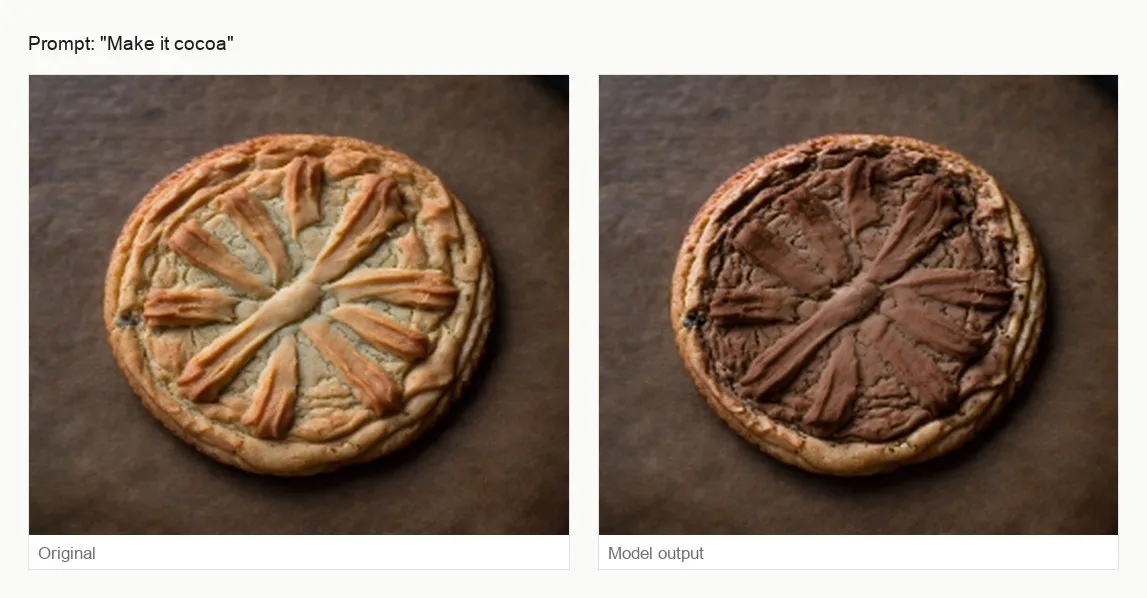
Some prompts were ambiguous, overly broad, multi-step, or in direct conflict with the content of the image. These cannot be resolved by preference. They need structured reasoning and a documented decision, so that two raters facing the same ambiguity resolve it the same way.
5. Guideline ambiguity
The model kept evolving, so the rubric had to as well. Acceptable versus unacceptable transformations, realism thresholds, and the editing boundaries around sensitive subjects all needed continuous revision rather than a single sign-off at kickoff.
How Hugo Approached It
Upfront preparation
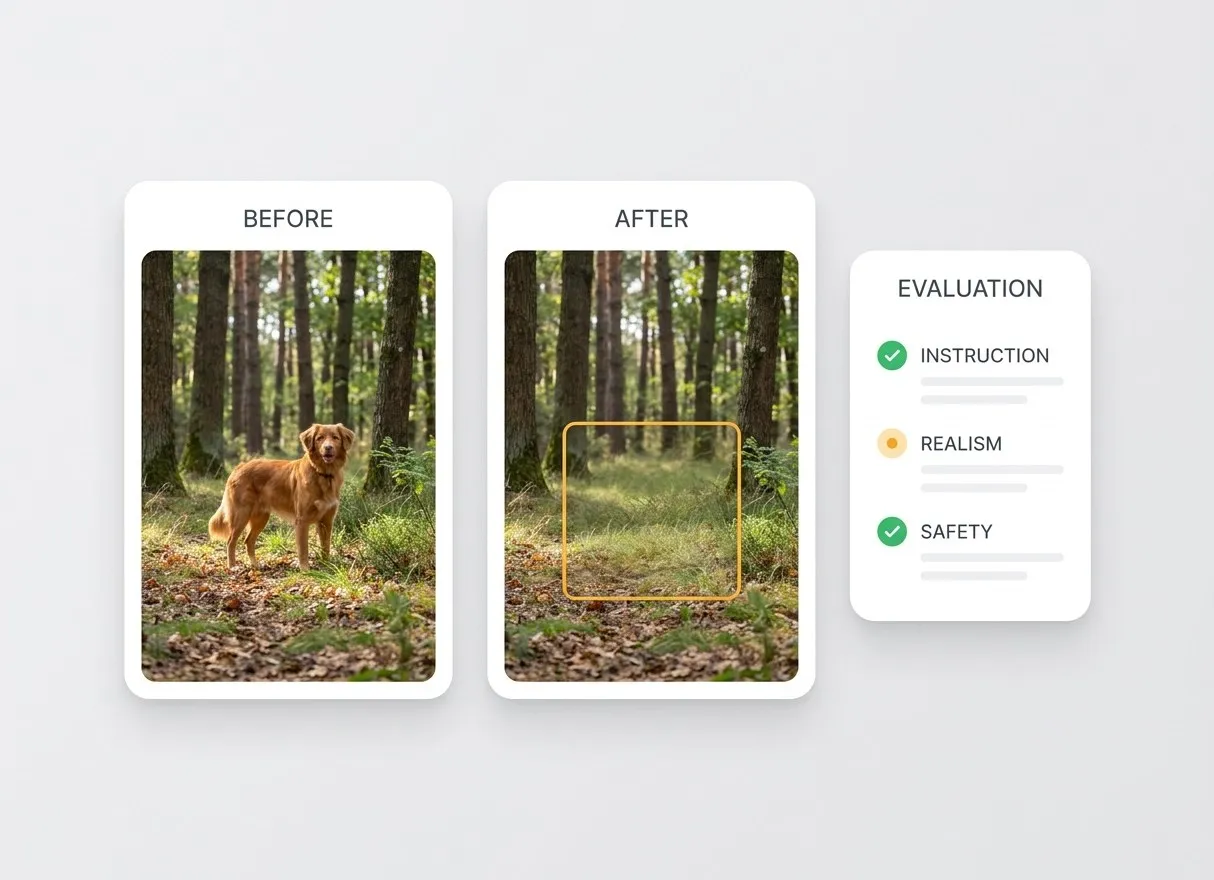
Before any volume ran, the team built edit-evaluation SOPs covering visual grounding, edit realism, artifact detection, safety categories and misalignment patterns. We created before-and-after comparison frameworks so that consistency had a reference rather than a memory, and an image-editing taxonomy specifying types of modification and their failure modes. An image stylization database catalogued style effects with definitions and key characteristics. Calibration sessions across sample transformations closed the loop before the first production batch.
Team structure
Drawing on the structure of comparable multimodal programmes, the team combined raters with strong visual literacy and perception skills, QA leads holding consistency across realism and safety judgments, subject-matter experts for ambiguous transformation cases, and a project manager owning ramp-up, root-cause cycles and guideline refinement.
The rater profile mattered more than headcount. The work needed attention to detail under a target handling time, familiarity with facial features and image styles sufficient to judge identity preservation and style alignment, critical thinking against the guidelines rather than around them, the adaptability to absorb rubric changes mid-flight, and the communication discipline to document an uncertainty instead of quietly guessing.
The evaluation workflow
- Instruction adherence check. Did the model understand the request, apply the correct transformation, and ignore extraneous or contradictory edits?
- Visual realism scoring. Naturalness of the edit, colour and lighting consistency, and the absence of artifacts or warping.
- Integrity and safety review. Sensitive or unsafe modifications, identity distortion, inappropriate body or face edits, and policy violations.
- Grounding verification. Does the edit align with the original visual content, with no hallucinated objects or attributes introduced?
- Justification and categorization. Structured reasoning attached to every judgment, tagged by failure mode, error type and level of misalignment.
That last step is what converts an evaluation into a usable signal. A score tells a research team how often the model failed. A tagged justification tells them what broke.
Results
- 276,565 annotations completed in 10 weeks.
- 88.31% quality against an 80% target.
What the Data Showed
Realism assessment demands visual acuity
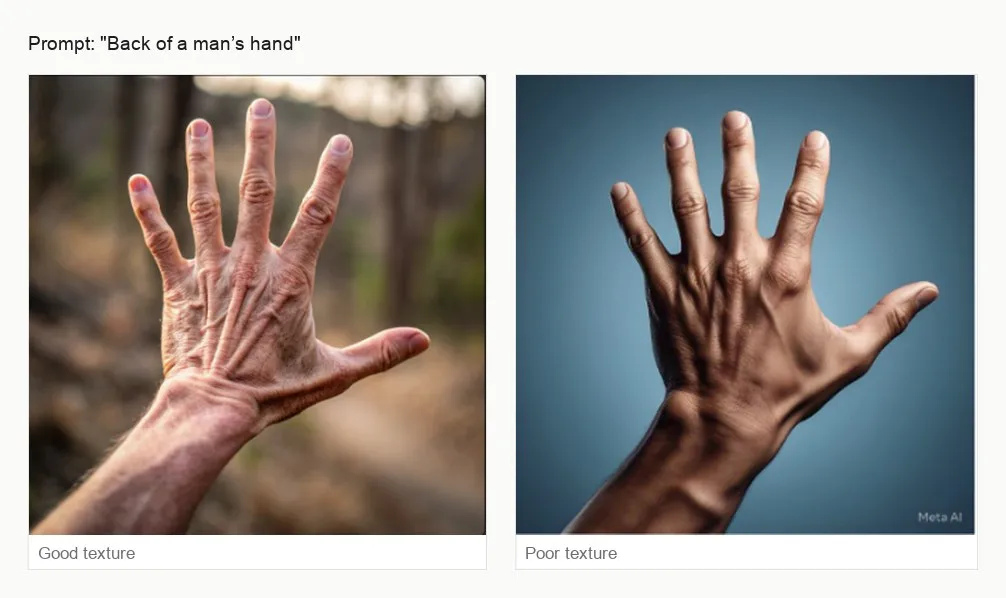
Minor artifacts drove a disproportionate share of failures. Lighting mismatches, background composition errors and texture distortion were the common modes, and all three are easy to miss at speed.


Instruction misinterpretation was the frequent error
The recurring pattern was not refusal but overreach. Models over-applied edits, modified unintended areas, added hallucinated objects or attributes, and missed the subtler nuances of an instruction.
Safety needed constant reinforcement
Especially around human subjects, sensitive objects and environments, and the boundaries of body editing. This is not a one-time rubric item. It degrades without active reinforcement.
Calibration improved consistency
Reviewing before-and-after examples together produced the single largest improvement in evaluator alignment.
Edit quality varied by scenario
Well-lit scenes were handled markedly better than dark environments, busy indoor scenes, and photos containing multiple people or overlapping objects.
Impact
The evaluation programme identified systematic weaknesses in image-editing fidelity, improved visual-grounding capability, and sharpened the rubric used to judge generative visual transformations. It produced insights that fed directly into model fine-tuning and safety adjustments, and left behind a repeatable structure for editing-evaluation work at scale.
High-judgment multimodal evaluation is not annotation with pictures attached. It asks a person to hold an instruction, an original image and a generated output in mind at once, and to say precisely which of the three is at fault. That is the work, and it is the part that does not automate.
Where This Sits in Hugo's Evaluation Stack
Image-editing evaluation combines perception, multimodal grounding and safety review. It is part of Omni Evals, Hugo's human evaluation practice for frontier models.