The Client
A global technology company was advancing multimodal AI models capable of understanding video and image content. To support its search infrastructure, these models needed to accurately interpret visual content, infer implied meaning, and understand user sentiment.
Hugo was engaged to execute a structured head-to-head evaluation of two multimodal models across video and image content. The objective was to generate reliable human evaluation signals to support model iteration and research validation across 15 evaluation dimensions.
These dimensions spanned summarization, semantic and multimodal extraction, classification, and content integrity, covering tasks such as entity recognition, scene segmentation, speech and sound recognition, OCR, emotional tone, editorial intent, and sensitive-content detection.
Partnership at a Glance
- Operational Scope: Head-to-head benchmarking of two multimodal models across up to 15 evaluation dimensions spanning five categories.
- Scale: 33,473+ multimodal evaluations delivered, with the team scaling from 35 specialists at pilot to 301 at full production across day, night, and weekend shifts.
- Speed: Production readiness achieved within 48 hours of pilot launch.
- Quality: Evaluation precision improved from 68% to 92% within the first four production weeks, a 24-point improvement achieved while scaling from 35 to 301 specialists.
- Technical Complexity: Multi-dimensional scoring across summarization, entity recognition, OCR, transcription, classification, and integrity, often within short, dynamic video clips.
- Quality Model: Daily calibration, feedback integration, targeted coaching, and Trace-Level Convergence Auditing to align judgment and prevent scoring drift as guidelines evolved.
The Challenge
Scaling multimodal evaluation required consistent judgment across a complex scoring framework, even as guidelines, production volume, and operational requirements continued to evolve.
- Multi-dimensional scoring increased evaluation complexity: Each piece of content could require simultaneous assessment across multiple dimensions, from summarization and entity recognition to OCR, transcription, classification, and integrity.
- Subjective criteria created consistency risks: Distinguishing minor issues from critical errors required nuanced judgment around hallucinations, omissions, inferred context, and evolving guidance.
- Tooling changes introduced operational friction: Audio issues, UI inconsistencies, submission errors, and output-formatting anomalies disrupted evaluation workflows and introduced quality risks.
- Integrity evaluation required contextual judgment: Sensitive content, age appropriateness, foreign-language content, and policy-aligned rejection criteria required evaluators to consider context and risk, not just literal accuracy.
- Scaling operations increased the risk of scoring drift: Continuous guideline updates and quality refinements had to be incorporated while maintaining throughput across an expanding, multi-shift operation.
The Solution
Hugo built a structured human-in-the-loop evaluation workflow around specialized multimodal reasoning, systematic evaluation, and continuous calibration.
AI Alignment Specialists
Hugo selected specialists with experience in high-judgment, audit-driven evaluation environments. Selection emphasized attention to detail, multimodal reasoning, familiarity with structured rubrics, adaptability to evolving guidelines, and consistent application of complex scoring logic.
Specialists followed a repeatable evaluation process supported by structured guidance, ongoing coaching, and continuous calibration.
Systematic Multimodal Evaluation
Each piece of content followed a structured evaluation process:
- Full-content review: Specialists established the context, narrative, and primary subject matter before scoring.
- Summarization assessment: Outputs were evaluated for narrative accuracy, key entities, actions, and unsupported or hallucinated details.
- Entity and multimodal verification: Specialists assessed entities, activities, OCR, transcription, scene segmentation, and key moments against the source media.
- Classification and integrity review: Outputs were evaluated for topic, emotional tone, editorial intent, intended audience, policy-sensitive content, and age appropriateness.
- Dimension-level scoring: Final ratings were applied across all relevant dimensions, with structured justification for critical errors, omissions, and misidentifications.
Continuous Calibration and Trace-Level Convergence Auditing
Hugo achieved production readiness within 48 hours while establishing the controls needed to maintain scoring consistency as the program expanded.
This included:
- Documented scoring standards covering every evaluation dimension.
- Internal certification to validate evaluator readiness before production.
- Centralized clarification tracking to capture evolving client guidance.
- Daily calibration and targeted coaching to reduce scoring drift and reinforce consistent judgment.
- Scaled quality oversight to maintain evaluation standards as operations expanded across day, night, and weekend shifts.
The Results
Hugo delivered reliable benchmarking signals at production scale while evaluation precision steadily improved.
| Metric | Result |
|---|---|
| Multimodal Evaluations Delivered | 33,473+ |
| Team Scale | 35 specialists → 301 |
| Shift Coverage | Single shift → Day, night & weekend operations |
| Evaluation Precision | 68% → 92% (+24 points) |
| Production Readiness | 48 hours |
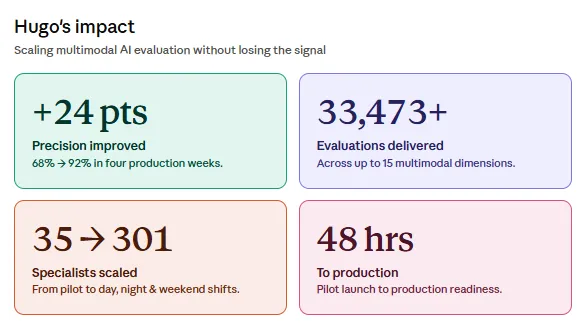
The 24-point improvement in evaluation precision was achieved while the team expanded from 35 to 301 specialists, demonstrating that scoring consistency strengthened rather than drifted as the program scaled. Daily calibration and structured feedback helped maintain alignment with evolving evaluation criteria across teams and shifts.
Conclusion
Reliable model benchmarking depends on the stability of the human signal behind it. As evaluation dimensions, guidelines, and edge cases evolve, consistent human judgment becomes essential to producing reliable benchmarking signals.
By combining rapid deployment, specialized AI Alignment Specialists, systematic multimodal evaluation, continuous calibration, and Trace-Level Convergence Auditing, Hugo delivered a human evaluation program that became more precise as it scaled, supporting faster model iteration and more confident benchmarking decisions.
"As the program scaled, Hugo consistently delivered the quality we relied on for model benchmarking. They adapted quickly as requirements evolved, becoming a trusted extension of our research team."
— AI Evaluation Lead, Global Technology Company