I’ve spent the last decade in the trenches of data operations and human-in-the-loop (HITL) architecture. I built and managed machine learning annotation infrastructure and crowd marketplace models at TaskUs and TaskVerse, helped scale AI-native operational systems at AgentsOnly prior to its acquisition by Teleperformance, and today at Hugo, I focus on the sophisticated side of AI services nobody’s talking about—upstream dataset design, multi-turn RLHF, omni-evaluations, and full-spectrum AI ops powered by high-aptitude talent in global tech hubs like Lagos, Nigeria.
— Sean Neighbors, Strategic Account Executive, Hugo
When Meta announced its $14.3 billion investment for a 49% stake in Scale AI last June—and brought founder Alexandr Wang over to lead Meta’s Superintelligence efforts—most commentary focused on immediate optics: a hyperscaler taking a massive equity position in the platform every frontier lab relied on for training data.
Thirteen months later, we don't have to speculate about what that structural shift meant for the market. We can look at what actually happened.
Key Takeaways
- The Enterprise Realignment: Scale AI's non-Meta enterprise business has experienced noticeable friction. Multiple labs pulled back or diversified, with 2026 revenue guidance sitting around $1 billion—down sharply from pre-deal trajectories.
- Leadership Priority Realities: With Alexandr Wang running Meta's internal AI organization and Scale operating under interim leadership, enterprise clients faced a clear priority dilemma regarding whose roadmap came first.
- The Pivot to Defense: Facing enterprise pullback, Scale leaned aggressively into government and defense work—highlighted by a $500 million Pentagon contract this year, five times the size of its deal the previous fall.
- The Procurement Takeaway: This isn't a critique of Scale’s execution; it’s a case study in supply chain risk. When a "neutral" data vendor gets absorbed into a competitor’s orbit, enterprise buyers must price that risk into their operations.
The End of Data Neutrality as a Default
In AI data operations, neutrality isn't a marketing tagline—it's an operational prerequisite. For years, Scale served as the default clearinghouse because frontier labs trusted that their proprietary training data, edge cases, and RLHF taxonomies wouldn't end up giving a competitor an edge.
That changed the moment a single competitor took a near-half stake and absorbed its chief executive.
The interesting part a year later isn't that the deal created a theoretical conflict of interest. It's that the market responded concretely: several major non-Meta customers scaled back or walked away. Passing custom alignment pipelines, red-teaming benchmarks, and multi-turn prompt libraries through a vendor tied directly to Meta created an enterprise risk profile that procurement and security teams simply couldn't justify.
Vertical Integration and Supply Chain Friction
What we've witnessed over the past year is classic vertical integration playing out across the AI stack:
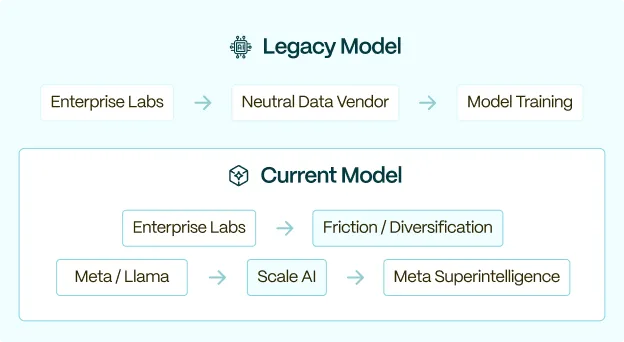
When Big Tech consolidates compute, model architecture, and human evaluation data, independent labs are left with a fundamental operational question: When expert workforce capacity is constrained, whose pipeline gets prioritized?
What 13 Months of Market Data Revealed
1. Intellectual Property & Alignment Exposure
Your training data is your true enterprise moat. The taxonomies you build, the edge-case jailbreaks you engineer, and the RLHF preference rankings you curate define how your model behaves—and where it fails. Routing that through a provider tied to a direct competitor gives that competitor structural visibility into your evaluation benchmarks. The labs that left quickly understood that model alignment is a zero-trust domain.
2. Resource Reallocation & The Defense Pivot
As enterprise lab revenue tightened, Scale made a logical business pivot: expanding into federal defense work, landing a $500M defense contract this year compared to $100M the year before.
While rational for Scale, it altered the workforce equation for enterprise clients. The high-reasoning expert talent pools weren't just balancing Meta vs. third-party labs—they were also being absorbed by massive federal programs. The "shared" expert pool enterprise clients relied on was being pulled in a third direction.
3. Valuation Multiples vs. Unit Economics
Scale’s valuation has held near $29 billion even as its 2026 revenue guidance sits around $1 billion. That multiple reflects heavy government and Meta alignment, but for enterprise clients, it introduces pricing inefficiencies. Enterprise buyers end up paying software-like valuation markups on what is fundamentally managed human intelligence and data operations.
Rearchitecting Your Post-Training Data Selection
Ripping out a data vendor without a plan is reckless; diversifying your supply chain intelligently is good governance. As the market moves away from commodity data labeling toward upstream dataset design, omni-evaluations, and full-spectrum AI ops, enterprise leaders should evaluate partners against four concrete criteria:
- Uncompromising Ownership Independence: Zero model-building operations, zero equity ties to competing hyperscalers, and zero leadership overlap.
- Talent Continuity over Gig Crowds: High-reasoning RLHF requires dedicated, university-educated teams with low attrition—not unmanaged crowd workers jumping between tasks on a marketplace platform.
- Strict Data Sovereignty: SOC 2 Type II compliance, air-gapped optioning, zero cross-tenant data reuse, and taxonomies that stay fully portable.
- Transparent Unit Economics: Pricing based on direct, auditable labor and operational management rather than valuation-driven rate cards.
Full disclosure: This exact set of criteria is why I joined Hugo. Having managed crowd platforms in previous roles, I watched worker churn destroy inter-annotator agreement (IAA) on complex, multi-month training runs.
Hugo was built specifically as a dedicated Cognitive BPO. We recruit university-educated talent in emerging tech hubs like Lagos, Nigeria, giving enterprise teams dedicated, high-retention units for complex SFT, multi-turn RLHF, and omni-evaluations—without the conflict-of-interest baggage or Big Tech overhead.
A Realistic, Low-Risk Migration Path
If you are evaluating vendor concentration, you don't need to halt an active training pipeline. A phased approach de-risks the switch while benchmarking output quality:
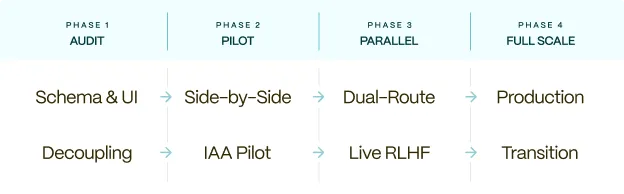
Phase 1 — Audit & Decoupling (Weeks 1–2): Inventory active annotation tasks, prompt schemas, and QA logic. Decouple your guidelines from any single vendor's proprietary UI so your workflows remain 100% portable.
Phase 2 — Parallel Pilot (Weeks 3–4): Run a side-by-side benchmark on a historical dataset batch. Compare inter-annotator agreement (IAA) on complex reasoning, edge-case adherence, and cost per unit.
Phase 3 — Dual-Routing (Weeks 5–6): Route a portion of live RLHF or fine-tuning traffic to the new partner. Establish direct API feedback loops and calibrate escalation channels with dedicated project leads.
Phase 4 — Production Scaling (Week 7+): Transition critical workflows under formal SLAs with complete end-to-end data isolation.
The lesson from the past 13 months isn't specific to Scale AI—it's that vendor neutrality is an operational asset you must underwrite explicitly, not assume. When a data partner’s ownership structure changes, their incentive structure changes with it.
For enterprise teams building proprietary AI, securing independent partners for upstream training and omni-evaluations isn't just about risk mitigation. It’s how you preserve your competitive moat, maintain training velocity, and keep your data pipelines clean.